

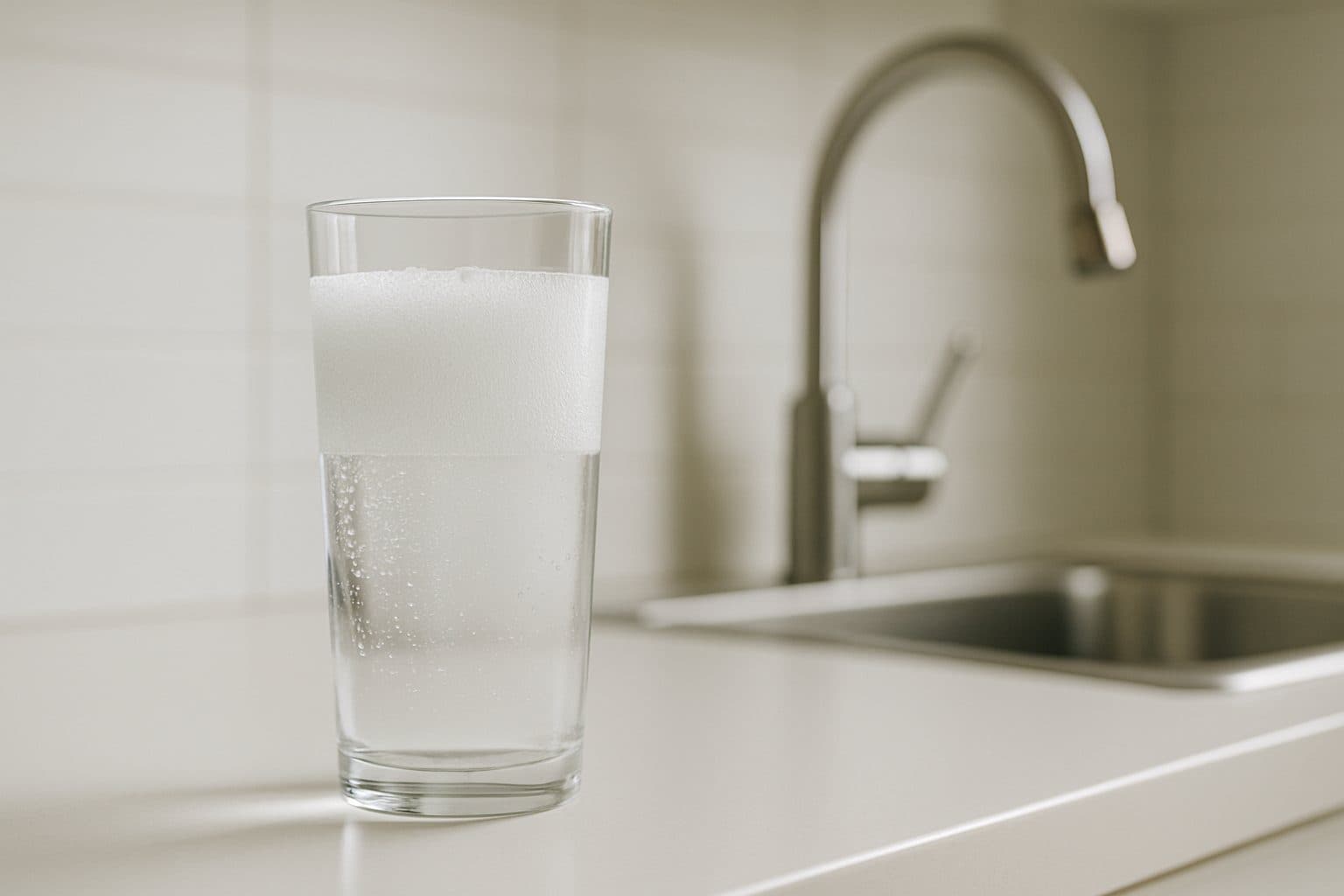
This is the most common water complaint there is, and the one most likely to end in equipment nobody needed.
The good news is that you can settle it yourself in about thirty seconds, without a test kit and without anyone visiting.
The test
Fill a clear glass from the tap. Set it on the counter. Watch which way it clears.
Bottom up — that is air. Millions of tiny bubbles rising. The clear zone starts at the bottom of the glass and climbs. Within a minute or two the whole glass is clear.
Top down — that is particulate. Solids settle. The clear zone starts at the top and descends, and you will usually see something at the bottom when it is done.
No change after several minutes — something is genuinely suspended, and that is worth a proper look.
That single observation does more diagnostic work than most of what gets written about cloudy water, and it costs nothing.
Why air is so common
Water in a pressurised main holds more dissolved gas than water at room pressure can. Open a tap and the pressure drops instantly, the gas comes out of solution, and for a few seconds you are looking at a glass of extremely fine bubbles.
It happens more when:
- Water is cold. Cold water holds more dissolved gas, so winter and early morning are worse.
- The utility has been working on the main. Air gets introduced during repairs and takes a while to clear.
- You are on a well with a waterlogged pressure tank. A tank that has lost its air cushion can push air through the system.
None of those are water-quality problems. Two are not problems at all.
Hot-only cloudiness
If it is only the hot tap, that is a useful narrowing rather than a worry. Heating drives dissolved gas out of solution — the same reason a pan of water develops bubbles on the bottom well before it boils. Hot water from a given tap routinely looks milkier than cold.
If hot-only cloudiness clears from the bottom up, your water heater is doing ordinary physics.
When it is worth pursuing
Take it further if:
- It does not clear after five minutes
- It clears top-down and leaves sediment you can see
- It is new and persistent, rather than intermittent
- It arrives with a taste, smell or colour change — cloudiness alone is weak evidence, cloudiness plus a second symptom is much stronger
- You are on a well and it follows heavy rain, which can point at surface water reaching the wellhead
That last one matters here. The formation most local wells draw from is highly permeable, so what happens at the surface can reach the water more readily than in a tighter aquifer.
What not to buy
If the glass clears from the bottom up, no filter will change anything, because there is nothing there to remove. A sediment filter catches particles; it cannot catch dissolved gas.
Anyone who quotes you equipment for cloudy water without asking which way the glass cleared has skipped the only free diagnostic available.
If it turns out to be the other case, a free in-home test reads what is actually there — and sometimes tells you that you need nothing, which is a legitimate outcome we are happy to deliver.
General guidance rather than a diagnosis. Sudden, persistent changes in water appearance, especially with taste or odour, are worth reporting to your utility or having tested — your utility is obliged to investigate.