

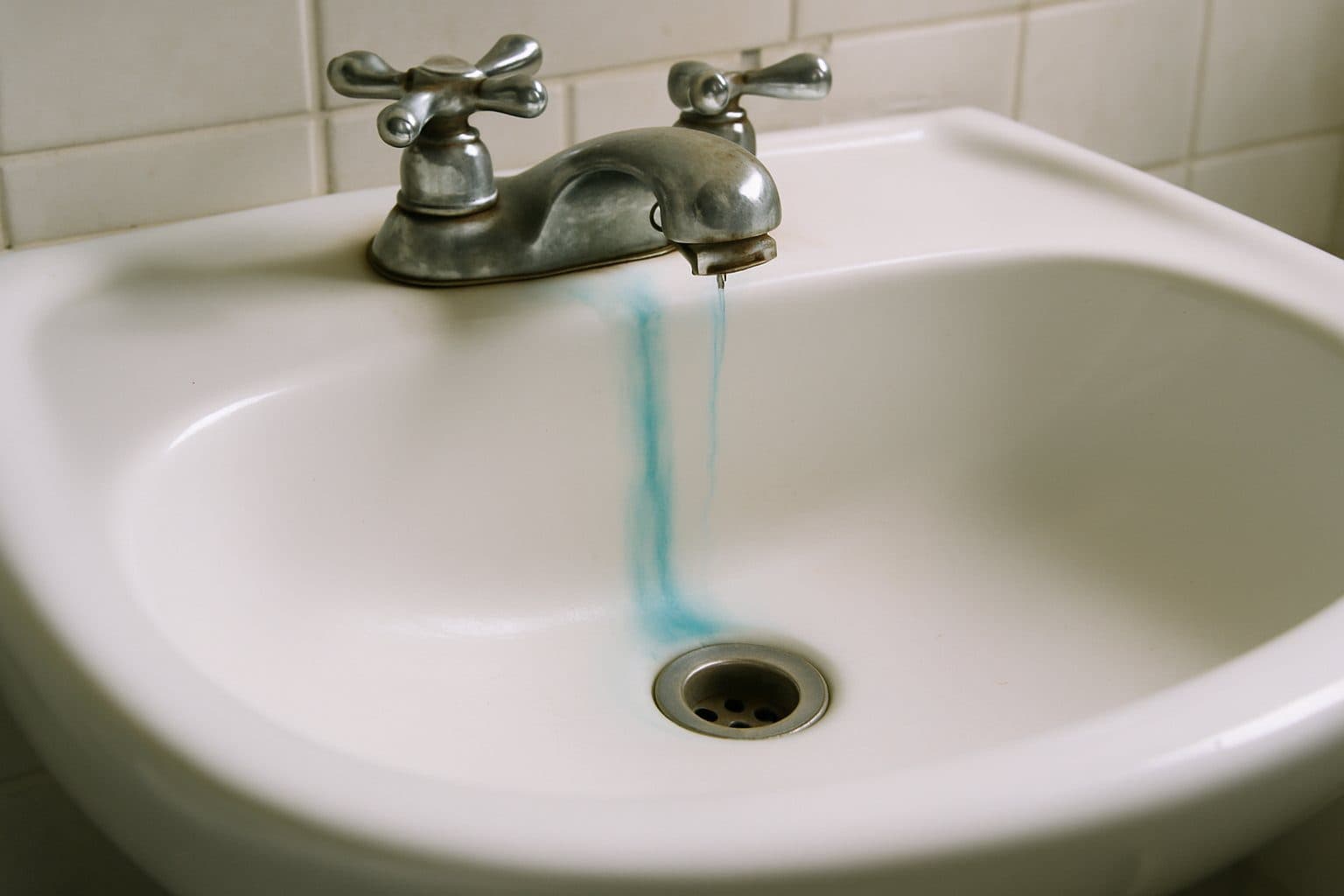
A blue-green stain under a tap is one of the few water problems that tells you exactly what is happening, if you know what it is.
It is copper. It came from your own pipes. And it means the water is slowly dissolving them.
The mechanism
Copper plumbing is stable in water that is roughly neutral. As pH falls, water becomes progressively more aggressive toward metal, and copper starts going into solution — a few molecules at a time, continuously, everywhere the water touches pipe.
That dissolved copper travels to your fixtures. Wherever water sits and evaporates — around a drain, at the base of a tap, in a tub — the copper is left behind as a blue-green deposit.
Scrub it off and it comes back, because the supply is continuous. The stain is not the problem. It is the receipt.
Why this is a local issue
USGS groundwater sampling across these two counties gives a median pH of 6.69 in Mobile County and 6.88 in Baldwin.
Copper corrosivity becomes noticeable below roughly 6.5. Those medians sit just above that line — which means the median well is fine and a substantial share of individual wells are not. A median is the middle of a distribution, and half of everything is below it.
The reason is the geology. Most local wells draw from the Citronelle Formation, which is quartz sand and gravel with very little carbonate in it. Carbonate is what buffers water toward neutral. Water moving through sand picks up almost none of it, so it arrives at your house close to the pH it fell as rain — and rain is mildly acidic to begin with.
What else it costs you
Copper pipe is the visible symptom. Acidic water works on everything metal it touches:
- Pinhole leaks in copper lines, typically after years of thinning, and typically in the least convenient place
- Brass and bronze fixture components — valve seats, cartridges, the small parts that make a tap stop dripping
- Water heater elements and tanks, where heat accelerates everything
- A metallic taste, which is dissolved copper you can detect at concentrations well below any health threshold
The plumbing damage is cumulative and quiet. Nobody notices a pipe getting thinner.
How to know rather than guess
The stain is strong evidence, not proof. Two numbers settle it:
pH, which tells you whether the water is aggressive. Copper at the tap, which tells you how much is actually being dissolved. The EPA action level is 1.3 mg/L — below that it is a nuisance question, above it a health one, and infants are the sensitive group.
Worth knowing: copper concentration is highest in water that has been sitting in the pipe overnight. A first-draw sample and a flushed sample can differ substantially, and a test that does not say which it was is hard to interpret.
The fix
An acid neutraliser — water passes through a bed of calcite media, which dissolves slowly and raises pH toward neutral. It is mechanical, has no moving parts, and needs the media topped up periodically rather than serviced.
What does not fix it: filtration of any kind. A carbon filter improves taste and does nothing about pH, so the pipe keeps dissolving behind it. If someone proposes a filter for blue-green staining, the proposal does not match the problem.
If you are seeing the stain, a laboratory pH result is the number to get — it tells you whether you are looking at an aggressive-water problem or something else. A free in-home test covers hardness, chlorine and TDS plus a soap test, which fills in the rest of the picture. More on pH correction and on what the local aquifer is doing.
Groundwater medians from USGS sampling for Mobile and Baldwin counties as compiled in this site's data layer; copper action level from EPA's Lead and Copper Rule. Verified 19 August 2026. County medians describe a region, not your well.