

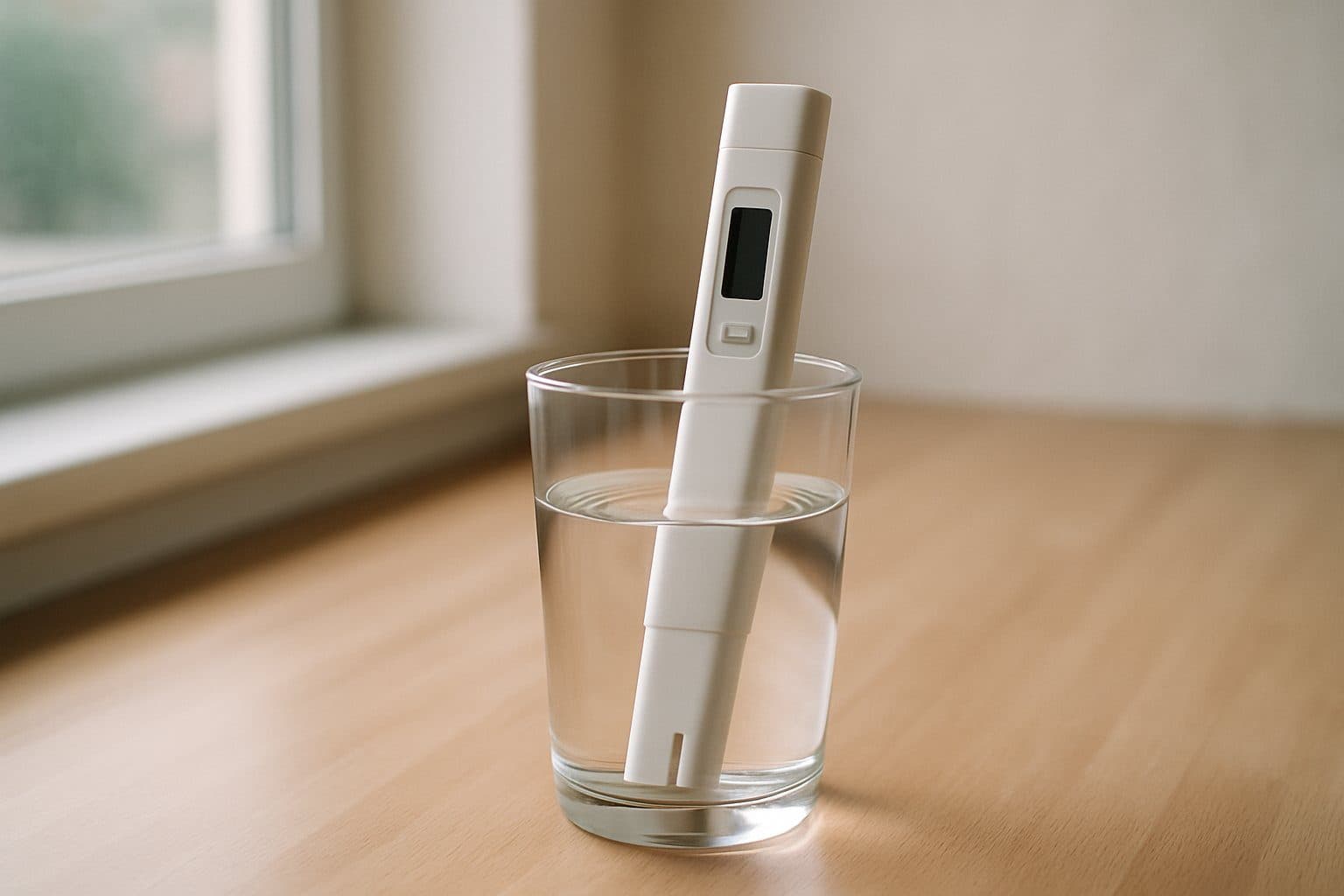
A TDS meter is the most-sold water test instrument in the world, and the number it produces is the least diagnostic thing on a water report.
That is not a reason to ignore it. It is a reason to know what it measures.
What TDS actually is
Total dissolved solids — everything dissolved in the water, added together and expressed as one figure in mg/L or ppm. Calcium. Magnesium. Sodium. Bicarbonate. Chloride. Sulfate. Nitrate. Trace metals.
The meter does not identify any of them. It measures electrical conductivity and converts it to an estimate of dissolved content, because dissolved ions carry current and pure water does not.
One number, no composition.
The standard, and what it is for
EPA's secondary standard is 500 mg/L. Secondary standards are about taste, odour and appearance rather than health, and they are not enforceable.
So "under 500" means "unlikely to taste strongly of minerals." It does not mean safe, and above 500 does not mean unsafe. Mineral water people pay for routinely exceeds it.
Why low is not automatically good
This is the part the marketing gets backwards.
A reading of 40 mg/L could be reverse-osmosis water. It could equally be soft, mildly acidic water moving through a sand aquifer — which is common here, and which is actively dissolving copper plumbing on its way to your tap.
Both read low. One is treated water and one is an aggressive-water problem. TDS cannot distinguish them, and neither can anyone quoting you equipment off a TDS reading alone.
What it is genuinely useful for
Tracking change over time on the same source. A well that has read 180 for three years and suddenly reads 400 has changed, and that change is worth investigating even though neither number is alarming on its own.
Confirming an RO membrane is passing water. RO removes most dissolved solids, so a large drop across the unit means the membrane is doing something. This is the one place a TDS meter earns its keep.
Not for judging a carbon filter. Carbon targets chlorine, disinfection by-products and organics — things that barely register as dissolved solids. A carbon filter that leaves TDS unchanged is working exactly as designed, and a meter that shows "no improvement" is testing the wrong property.
The questions that actually decide treatment
None of them are TDS:
- Hardness, which decides whether a softener makes sense
- pH, which decides whether the water is attacking your plumbing
- Chlorine or chloramine, which decides which kind of carbon
- Iron, which decides what has to happen before anything else
Every one of those is a specific measurement of a specific thing, and every one of them points at a different answer.
The free in-home test reads hardness, chlorine and TDS together, plus a soap test, which is the combination that actually says something — and sometimes says you need nothing.