
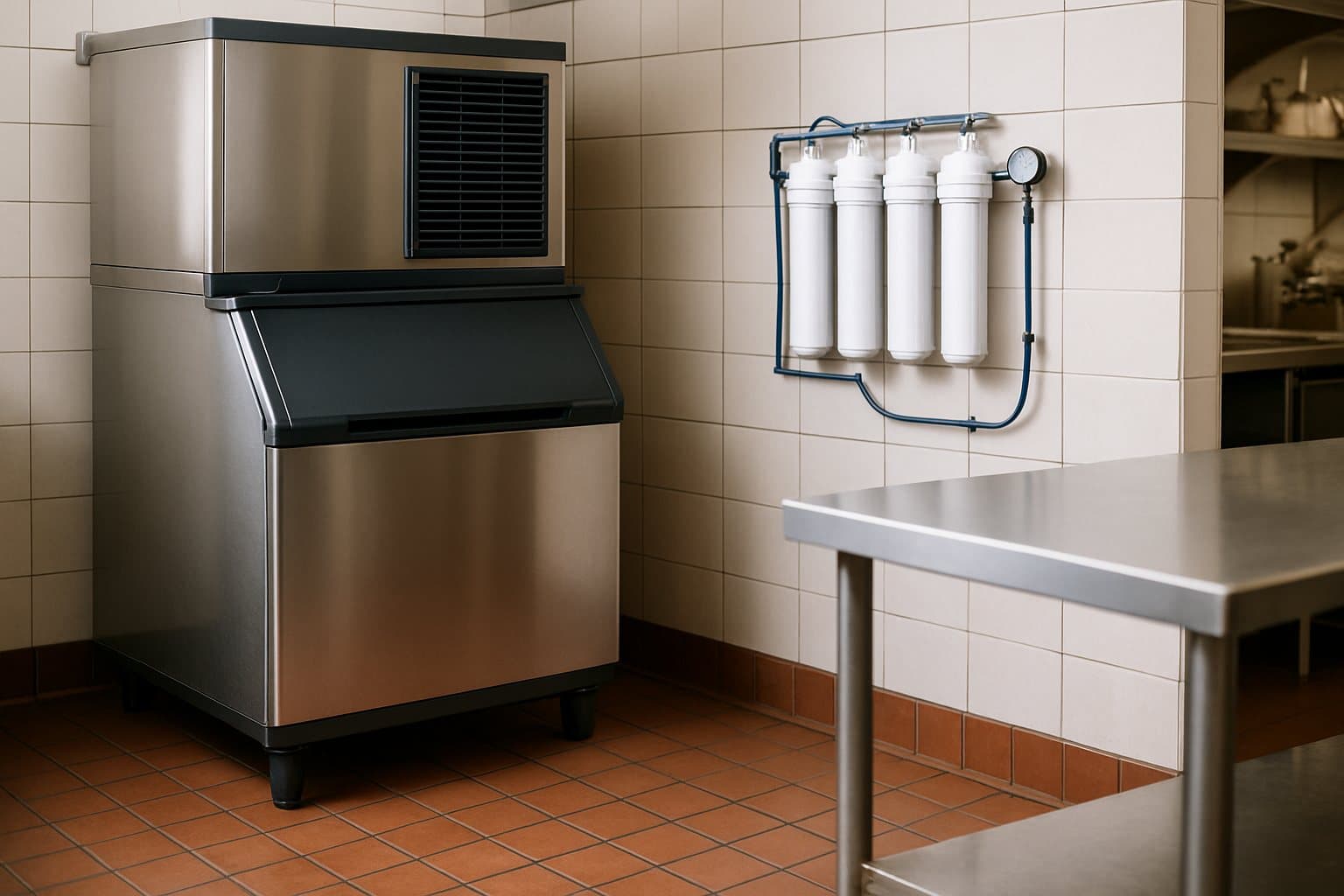
Ask what the best filter for a restaurant is and most answers name a product. A kitchen is not one water user, though. It is four or five pieces of equipment, each with its own manual and its own water specification.
What is the best water filtration system for a restaurant?
There is no single best unit. The best system treats each line to what its equipment maker specifies: carbon where chlorine reaches ice and drinks, scale control where water is heated, and nothing extra where the maker says not to. It should be designed as one plan with one service record, built on your utility's actual water.
That is the approach behind our restaurant water treatment work: start from the equipment manuals and the utility report, then decide what each line needs.
What do Alabama's rules actually require?
Alabama adopts the 2013 FDA Food Code for food establishments. The code does not mandate a particular filter. It requires ice made from drinking water, backflow protection at every point of use, and scheduled service with records for any water treatment device you install. Those three rules shape the whole design.
Alabama's food establishment sanitation rules (chapter 420-3-22) incorporate the 2013 Food Code by reference. The Mobile County Health Department publishes the combined document. The sections that matter for water:
- 3-202.16, Ice. "Ice for use as a FOOD or a cooling medium shall be made from DRINKING WATER."
- 5-205.13, Scheduling Inspection and Service for a Water System Device. A water treatment device "shall be scheduled for inspection and service, in accordance with manufacturer's instructions and as necessary to prevent device failure based on local water conditions, and records demonstrating inspection and service shall be maintained by the PERSON IN CHARGE."
- 5-202.13 and 5-203.14, Backflow. An air gap of at least twice the supply inlet diameter and never less than 1 inch, or an approved backflow prevention device, at each point of use.
- 5-203.15, Carbonators. Soda systems get their own backflow requirement: a vented dual check valve upstream of the carbonator where there is no air gap.
The service-record rule is the easy one to lose track of. Filters bought one at a time from different vendors each come with their own schedule, and the code expects you to keep up with all of them.
What does each piece of equipment need?
Each station has different water needs, and the manufacturer's manual is the authority. Ice machines want scale and chlorine controlled. Beverage lines want chlorine taste gone. Steam equipment often wants a minimum hardness and low chlorine. Some ovens say upstream softening is unnecessary, so check before you soften.
| Station | What the maker's manual says | What it usually points to |
|---|---|---|
| Ice machine | Manitowoc's QF0400 installation manual: "Local water conditions may require treatment of the water to inhibit scale formation, filter sediment, and remove chlorine odor and taste." Clean and sanitize at least every six months. | A filter and scale-inhibitor cartridge set matched to the machine, on a change schedule |
| Combi oven | RATIONAL's iCombi Pro installation manual: chlorine (Cl2) above 0.2 mg/L requires an activated carbon filter; do not use treated water under 5 °dH (about 90 ppm); minimum conductivity 50 µS/cm; upstream softening for scale "is not necessary" | Carbon, and no softener or straight RO water on the oven line |
| Fountain and coffee | Taste is the product; carbonators carry their own backflow rule | Carbon for chlorine taste and odor |
| Dish machine | Varies by model; check the spec sheet for a hardness limit | Softening only where the machine's spec and your hardness call for it |
The combi oven row is the one that surprises people. It is tempting to soften every line in a kitchen. For that oven, the maker specifically warns that very soft treated water "can have an aggressive and corrosive effect and shorten the service life of the unit." It also says the unit handles its own scale.
What does Mobile's water mean for a kitchen?
MAWSS water is soft and chlorinated. That shifts the priority from scale to chlorine. At up to 2 ppm, the chlorine residual in the 2025 report is ten times the level at which RATIONAL requires a carbon filter. The hardness, meanwhile, is soft by the USGS scale.
From the MAWSS 2025 water quality report:
- Chlorine residual: 0.29 to 2 ppm. That is legal, since the maximum is 4, but it is well above RATIONAL's 0.2 mg/L carbon-filter threshold.
- Hardness: 38.3–49.6 mg/L, about 2.2 to 2.9 gpg. That is soft by the USGS scale, and below RATIONAL's 5 °dH minimum for treated water. The oven manual has a separate setting for supplies under 7 °dH.
- Specific conductance: 111 to 129 µmho/cm, above the oven's 50 µS/cm minimum as supplied. Reverse osmosis would pull that down, which is one more reason not to feed RO water to steam equipment without checking the manual.
In Baldwin County the picture depends on the utility. Daphne Utilities, for example, reported hardness of 15.3 to 27.6 mg/L for 2025 in its 2026 report. Read your own utility's report before anyone sizes equipment.
Where do softeners and RO fit in a restaurant?
They fit where a manufacturer asks for them and your water needs them. That is not everywhere. A commercial water softener earns its place on equipment that scales and whose maker wants softened feed, especially on harder supplies. Reverse osmosis fits a beverage or espresso program that wants consistent low-mineral water, blended or remineralized to that equipment's spec.
Two practical notes:
- Regeneration timing. Softener valves usually regenerate overnight; Hydrotech's residential valve ships set to 2:00 a.m. That is why a softener runs at 2am. In a kitchen with overnight cleaning or early prep, set the time so that the unit is not regenerating while you draw water.
- One schedule, one log. Section 5-205.13 wants records. A single design with one service calendar for every cartridge, membrane and softener is easier to keep than a drawer of vendor stickers.
Ice gets the most attention for a reason. How often to replace an ice machine water filter covers change intervals. What a boil-water notice means for a restaurant ice machine covers what happens when the utility issues one.
Start with the numbers: your utility's annual report, and a reading at your own tap. The free water test screens hardness, chlorine, total dissolved solids and a soap test on the spot. Call (251) 292-3888 to talk through a kitchen.