

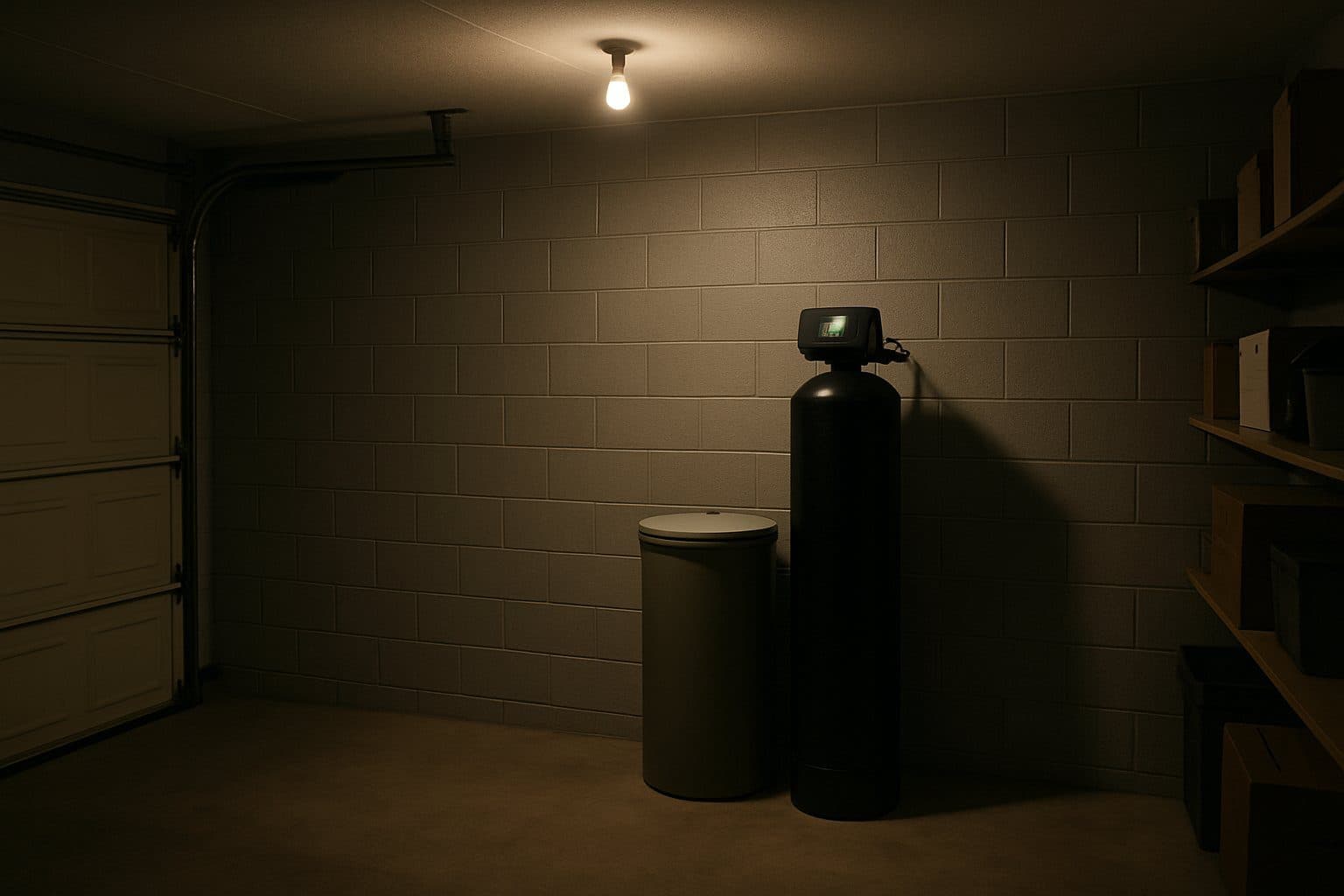
Almost every water softener is set to regenerate around 2am, and almost every owner eventually wonders why the plumbing is busy in the middle of the night.
It is deliberate, and the reason explains most of what the unit does.
What regeneration is
A softener works by ion exchange. Water passes through a bed of resin beads carrying sodium ions; calcium and magnesium in the water swap places with the sodium and stay behind on the resin.
That is finite. Eventually the resin is loaded with hardness and has nowhere left to put any more.
Regeneration reverses it. Concentrated brine from the salt tank is drawn through the resin, the sheer sodium concentration displaces the accumulated calcium and magnesium, and the whole lot is flushed to the drain. The resin comes out recharged and ready.
Why the middle of the night
Three reasons, all practical.
The unit is not softening while it regenerates. On a standard single-tank residential system, water is still available during the cycle — but it is hard water. At 2am nobody is showering through it.
It draws water. Backwash, brine draw and rinse all consume flow. Doing that while someone is running a shower or a dishwasher affects both.
The cycle takes a while. Roughly one to two hours from start to finish depending on the unit and settings. There is no convenient daytime window that does not collide with something.
Dual-tank systems avoid the outage entirely by alternating, which is the main argument for them.
It is a setting, not a fact
Any modern valve lets you change the regeneration time, and it is worth changing if your household is genuinely awake then — night-shift workers showering at 2am are the classic case.
Also worth checking: whether it regenerates on a timer or by metered volume. A timer-based unit regenerates every N days regardless of how much water you used, which wastes salt on weeks nobody was home and can run short after a busy one. Metered regeneration triggers on actual volume treated. Most valves support it and it is usually the better setting.
What the noises mean
Water moving, valves clunking as the cycle steps, and drain flow are all normal.
What is not normal is a cycle that never ends — water running to the drain continuously for hours. That usually means a valve stuck mid-cycle or a restricted drain line, and it will run up a water bill quietly and quickly. If you can hear drain flow at random times of day rather than in a defined block at night, that is worth investigating.
The related check
If you have never heard it regenerate and the salt level never drops, the unit is probably not regenerating at all — which looks identical to working from everywhere except a hardness reading. The four checks sort it out in about ten minutes.
The free in-home test includes a hardness reading either side of the unit, on any softener including one we did not install.