

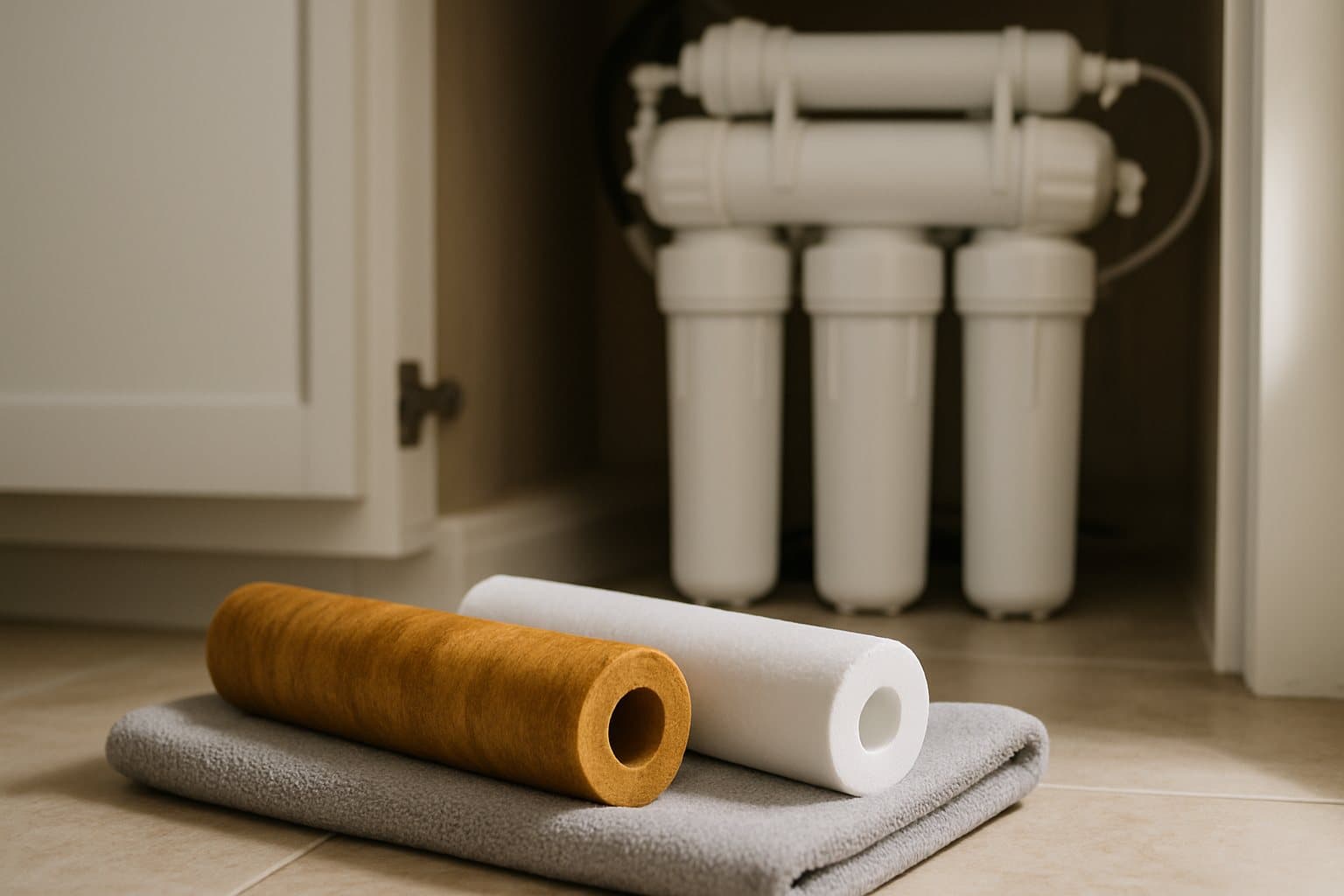
On Mobile city water, the carbon prefilter in a reverse osmosis system does more than improve taste. It is what stops the utility's disinfectants from reaching the membrane. MAWSS water carried free chlorine up to 2 ppm and chlorine dioxide up to 80 ppb in 2025. The membranes used in home RO units are damaged by both. A spent prefilter lets them through.
So the prefilter change is the maintenance item that decides how long an RO system lasts on this water. Keeping it on schedule is the whole point of our RO filter and membrane replacement service.
What disinfectants are in Mobile's water?
Free chlorine and chlorine dioxide. MAWSS's 2025 report lists chlorine at 0.29 to 2 ppm and chlorine dioxide at up to 80 ppb, both within their federal limits. The report also states that chloramine-forming additives were not used during 2025 treatment. Chlorite, the by-product of chlorine dioxide, reached 0.74 ppm against a 1 ppm limit.
Those figures come from MAWSS's Consumer Confidence Report for testing performed in 2025. The detail on chloramine is in the report's notes, which say chloramines and bromate "are by-products formed from water treatment additives" that were not used.
That matters for choosing filters, because chlorine, chloramine and chlorine dioxide behave differently. Our taste guide covers how to tell them apart.
Why does chlorine damage an RO membrane?
Most home RO membranes are thin-film polyamide, and chlorine oxidises polyamide. DuPont, the maker of FilmTec membranes, says degradation may occur after about 200 to 1,000 hours of exposure to 1 mg/L of free chlorine. It also says oxidation damage is not covered under its warranty, and that feedwater should be dechlorinated first.
That figure is from DuPont's technical manual excerpt on chlorination and dechlorination. The tolerance is expressed in ppm-hours, which means concentration multiplied by time. At MAWSS's highest reported residual of 2 mg/L, the low end of that range is reached after about 100 hours of contact rather than 200.
The same document adds two conditions that speed the damage up:
- Neutral or acidic pH. Chlorine attack is faster there than in alkaline water.
- Iron and other metals. They catalyse membrane degradation, on the membrane surface or in the water.
The first visible sign, according to DuPont, is a change in flux, meaning how much water the membrane passes. Then flux rises along with salt passage: more dissolved solids get through to your glass.
Is chlorine dioxide as hard on a membrane as chlorine?
It can be, and it should be treated the same way. DuPont lists chlorine dioxide alongside hydrogen peroxide, ozone and permanganate as oxidisers "capable of damaging RO/NF membranes also if not used properly." We found no published tolerance for chlorine dioxide at household levels, so the safe assumption is to remove it before the membrane.
MAWSS's chlorine dioxide residual is much lower than its chlorine residual: 80 ppb at most in 2025, against 2 ppm of chlorine. But the membrane sees both, every time the unit makes water, for as long as the prefilter is spent.
What does the carbon prefilter actually remove?
It reduces free chlorine to chloride, and that is the job the membrane depends on. DuPont calls an activated carbon bed "very effective" for dechlorinating RO feedwater. Carbon also helps with chlorite, according to the World Health Organization, though the WHO describes that at treatment-plant scale rather than for home cartridges.
In the tankless unit we install, the Aqua Flo CRO-800UX6 by Hydrotech, the carbon sits inside a single 3-in-1 cartridge. Hydrotech's owner's manual describes it as a sediment stage, a pre-carbon stage that "reduces chlorine which may damage the RO membrane filter," and a post-carbon stage for taste and odour.
Two details from that manual matter on Mobile water. It lists a maximum feed-water chlorine of 2.0 ppm, which is exactly MAWSS's highest reported residual. And it says the pre-carbon "must be regularly checked and/or replaced to prevent premature membrane failure."
One limit worth knowing: the WHO's background document on chlorine dioxide, chlorite and chlorate notes that granular activated carbon is generally not effective against chlorate, and names reverse osmosis as one of the technologies that can remove it. That is one more reason to keep the carbon and the membrane working together, rather than thinking of either one as the filter.
How often should the prefilter be changed on MAWSS water?
Follow the manufacturer, and plan for the shorter end of its range. For this unit Hydrotech lists 6 to 12 months or 2,000 gallons for the 3-in-1 cartridge, and 12 to 24 months or 3,200 gallons for the membrane. The manual says high chlorine can mean more frequent service, and Mobile's residual reaches the manual's stated ceiling.
The manual lists three signs that a cartridge is due, whatever the calendar says:
- The water tastes bad or the quality has dropped.
- The flow from the faucet has fallen sharply, and cold weather is not the reason.
- The filters are so clogged that almost no water comes out.
The unit's filter-life indicator turns from blue to red when a cartridge is exhausted, which takes some of the guesswork out of it. For RO systems without an indicator, a rise in total dissolved solids in the product water is the measurable warning. Our post on RO waste water explains why an ageing membrane also sends more water to drain.
Does a whole-house carbon filter change the picture?
Yes. It takes most of the disinfectant out before water reaches any tap, including the RO. The RO prefilter then becomes a second line of protection rather than the only one. It also treats shower and laundry water, which an under-sink unit never touches.
That is why the two work well as a pair on Mobile water. A whole-house carbon filter handles chlorine taste and by-products at every tap. The under-sink RO handles the dissolved substances carbon does not, at the one tap you drink from. If you are still deciding whether RO is worth it at all on this water, start here.
Your own chlorine reading may differ from the system-wide range, since residual changes with distance from the plant. The free in-home water screen reads chlorine, hardness and total dissolved solids at your tap and includes a soap test, which tells you where your house sits before you choose a filter or a change schedule. We work across Mobile and the surrounding MAWSS area.
MAWSS figures are from its Consumer Confidence Report covering testing performed January to December 2025. Membrane tolerance figures are DuPont's; cartridge intervals and feed-water limits are Hydrotech's published figures for the CRO-800UX6.