

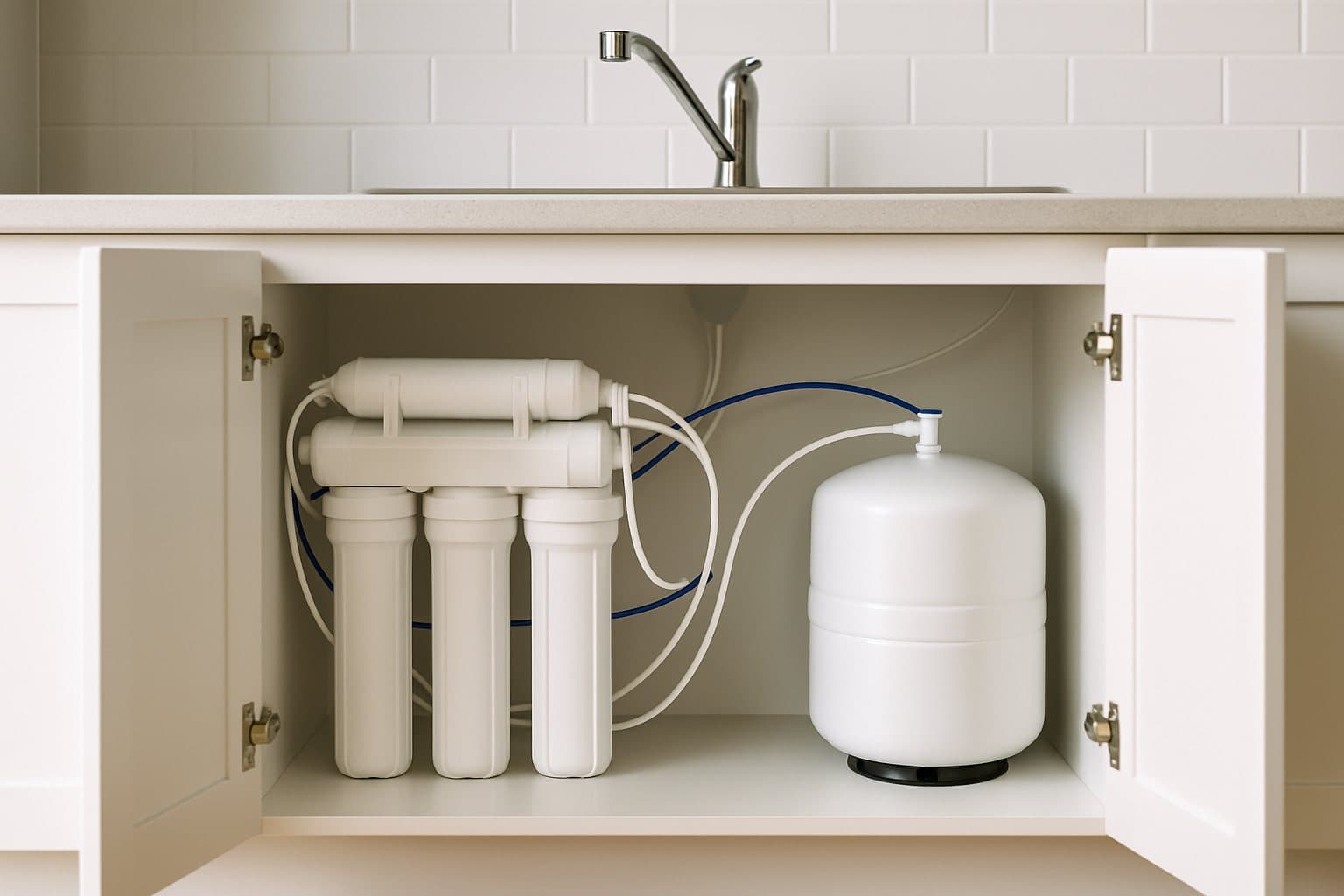
For most households on Mobile city water, an under-sink reverse osmosis system is worth it only if you want your drinking water to read lower than the legal limits allow, not because the water is failing them. The case is strongest for disinfection by-products, PFAS and lead from household plumbing. It is weakest for taste and for hardness.
That is a narrower answer than most RO marketing gives, so here is the evidence behind it.
Is an under-sink reverse osmosis system worth it on Mobile water?
It is worth it if your goal is lower numbers at the drinking tap. It is not worth it as a taste fix or a hardness fix. MAWSS water met every federal limit in 2025, but several regulated substances sat at a real fraction of their limits. RO reduces those at one faucet, and does nothing for the rest of the house.
The system we install for this is the tankless under-sink reverse osmosis system, and the decision about whether you need it should start with what the Mobile Area Water and Sewer System itself publishes.
What does the MAWSS water report show that RO can address?
The 2025 report shows three things worth reducing at the tap: by-products of disinfection, trace PFAS, and lead that enters from some homes' plumbing. All were legal. None were zero. These figures come from MAWSS's Consumer Confidence Report for testing performed January to December 2025.
| What MAWSS reported (2025) | Highest level | Federal limit |
|---|---|---|
| Total trihalomethanes (highest location's running average) | 67.25 ppb | 80 ppb |
| Haloacetic acids, HAA5 (highest location's running average) | 36.68 ppb | 60 ppb |
| Chlorite | 0.74 ppm | 1 ppm |
| PFOA | 2.0 ppt | 4.0 ppt |
| PFOS | 1.6 ppt | 4.0 ppt |
| Lead, single highest home sample (of 52) | 33 ppb | 15 ppb action level at the 90th percentile |
| Total dissolved solids | 83 ppm | 500 ppm (secondary) |
The lead row needs reading carefully. The 90th-percentile result across 52 homes was 1.5 ppb, well under the action level, which is how compliance is judged. The 33 ppb figure is one home. Lead comes from pipes and fixtures inside buildings, not from the reservoir, which is why one house can read very differently from its neighbours.
The by-product rows are the ones most specific to Mobile. MAWSS draws all of its water from one surface reservoir, Big Creek Lake, and treated surface water carries more of the organic matter that disinfectants react with. The system-wide profile, including independent readings, sits on the MAWSS water-quality page.
Which part of an RO system does the work?
Both halves do, on different things. An under-sink RO unit is a carbon filter and a membrane in one housing. The carbon handles chlorine and taste. The membrane rejects dissolved substances, including PFAS and lead. Buying RO for chlorine taste alone means paying for a membrane you did not need.
The EPA studied point-of-use filters for PFAS and found that the reverse osmosis, carbon and ion-exchange systems it tested "can greatly reduce PFAS levels." The same page makes a point worth keeping in mind: the certification standards for PFAS filters do not yet show that a filter will get PFAS down to the new federal drinking water limits. RO is a strong tool for PFAS. It is not a guarantee of a number.
When is RO the wrong answer on Mobile water?
When the complaint is taste, the shower, or scale. Mobile's water is already low in minerals and soft, so RO changes its taste less than it would in a hard-water city. It treats one tap, so it cannot help the shower. And it does not prevent scale on fixtures, because the house plumbing still carries untreated water.
Three specific cases:
- "It tastes like chlorine." MAWSS reported free chlorine as high as 2 ppm and also disinfects with chlorine dioxide. That taste is a carbon problem. Here is how to tell which disinfectant you are tasting.
- "The water is hard." MAWSS reported hardness of 38.3 to 49.6 ppm as calcium carbonate in 2025, or about 2.2 to 2.9 grains per gallon. The USGS classes anything up to 60 mg/L as soft. If you see scale, measure before you buy for it.
- "I want it for the whole house." We do not install whole-house RO, and on city water it rarely makes sense. The reject stream scales with every gallon, and treating toilet and laundry water to drinking standard buys nothing.
One more honest point: RO water can taste flat. That is expected when dissolved minerals are removed, and there is a straightforward reason for it.
What does the tankless system cost, and what does it do?
$1,895 installed. It is the Aqua Flo CRO-800UX6, built by Hydrotech: an 800 gallon-per-day membrane with no storage tank, delivering up to 0.62 gallons per minute to a dedicated faucet. Hydrotech rates it at about 2 gallons of purified water for every 1 gallon to drain.
What that looks like under the sink:
- No storage tank. Water is made on demand, so the cabinet stays usable.
- Two quick-change cartridges. A 3-in-1 prefilter and the RO membrane.
- Leak detector. It shuts the unit off and sounds an alarm if it senses water.
- Filter-life indicator. It tells you when a cartridge is due.
The 2-to-1 drain ratio matters if you have read that RO wastes several gallons for every one it makes. Older tank designs often did. This post covers what drives the ratio and why low water pressure makes it worse.
Every install carries our 1-year parts and labor warranty, and adding the $34.95/month maintenance plan extends it to a lifetime labor warranty.
Who on MAWSS gets the most from it?
Households that drink and cook with tap water and want the by-product, PFAS and plumbing-lead numbers lower than the utility is required to deliver. That includes families mixing infant formula and anyone in an older home that has not checked its own plumbing. It gets less from a household that mostly drinks bottled water.
MAWSS serves Mobile, Chickasaw, Tillmans Corner, Theodore and Semmes, among others. The by-product figures above are system-wide, and levels generally rise with distance from the treatment plant. Our Mobile service-area page covers the rest of what we see across the city.
Before spending anything, get your own tap measured. The free in-home water screen reads hardness, chlorine and total dissolved solids at your faucet and includes a soap test, with results on the spot. If the numbers say you do not need a membrane, we will tell you that.
MAWSS figures are from its Consumer Confidence Report covering testing performed January to December 2025. Product specifications are Hydrotech's published figures for the CRO-800UX6.