

People often ask for "a water softener" when what bothers them is the smell of the shower. Others buy a filter and are surprised the kettle still scales. The two machines solve different problems. The useful question is which problems your water actually has.
Do I need both a water softener and a water filter?
You need both only if your water has both problems: hardness that causes scale, and chlorine taste or odor. A softener removes calcium and magnesium. A carbon filter removes chlorine. Neither does the other's job. On Mobile's city water, which tests soft and chlorinated, the filter is usually the one that matters.
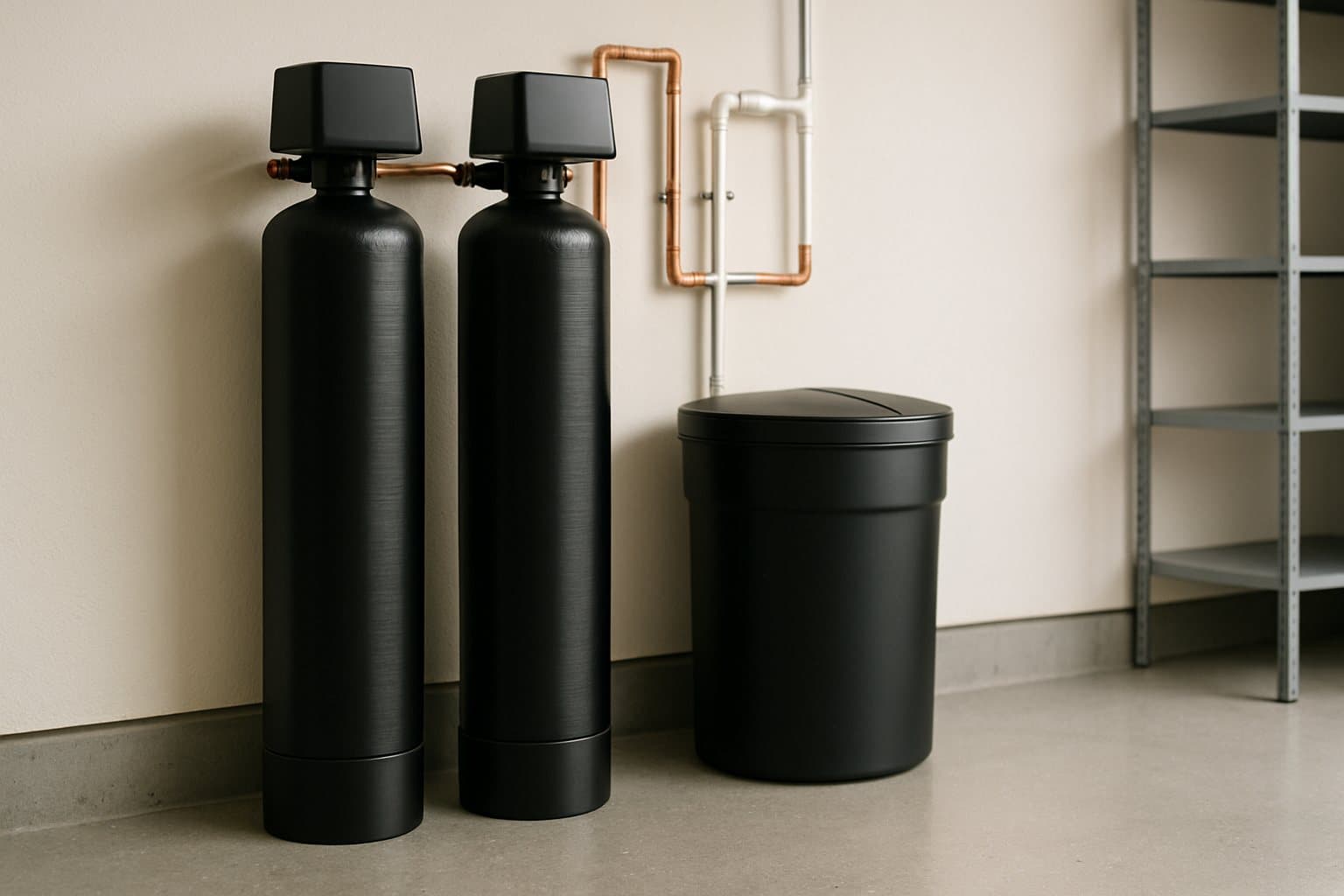
When a house does have both, that is what the whole-home dual tank system is for. It pairs a catalytic carbon stage with a softening stage on one control valve at the main line. The equipment is the Hydrotech HT89UF HTO, which its owner's manual lists as certified by IAPMO R&T against NSF/ANSI 42, 44 and 372. The system is $4,995. When the numbers only show one problem, paying for both stages is hard to justify.
What does each one actually remove?
A softener removes hardness minerals and nothing else of note. A carbon filter removes chlorine taste and odor and leaves hardness alone. Reverse osmosis at one tap removes most dissolved solids. The certification each one carries tells you which job it has been tested for.
| Equipment | What it is built to do | What it does not do | Standard |
|---|---|---|---|
| Water softener | Exchanges calcium and magnesium for sodium | Remove chlorine, taste or odor | NSF/ANSI 44 |
| Carbon filter (whole house) | Reduces chlorine taste and odor | Soften water | NSF/ANSI 42 for aesthetic claims |
| Under-sink reverse osmosis | Reduces dissolved solids at one tap | Treat the shower or the water heater | NSF/ANSI 58 |
The standard numbers come from NSF's summaries of filtration standards and water treatment standards. NSF/ANSI 42 covers aesthetic effects such as chlorine, taste and odor. NSF/ANSI 53 covers contaminants with a health effect. NSF/ANSI 44 covers residential softeners, and NSF/ANSI 58 covers reverse osmosis. Certification is claim by claim. A filter certified for chlorine taste has not been tested for anything else unless the listing says so.
What does Mobile's water actually carry?
MAWSS water is soft and disinfected with chlorine, so it rarely scales much but can taste and smell of chlorine. The 2025 report also lists disinfection by-products, all within legal limits. For most MAWSS homes, that profile points to filtration first and softening second.
From the MAWSS 2025 water quality report:
- Hardness: 38.3–49.6 mg/L, about 2.2 to 2.9 gpg. That is soft by the USGS scale, which runs up to 60 mg/L.
- Chlorine residual: 0.29 to 2 ppm. The legal maximum residual is 4.
- Chlorine dioxide: up to 80 ppb, against a maximum of 800. Chlorite, its by-product, peaked at 0.74 ppm against a limit of 1.
- Total trihalomethanes: highest running average 67.25 ppb, against a limit of 80. Haloacetic acids peaked at 36.68 ppb against 60.
- Chloramines: the report notes they were not used in treatment during 2025.
The chlorine is what most people notice, and the pool-like smell is strongest in a hot shower. Water that tastes like a swimming pool covers it.
One caution on by-products. A whole-house carbon filter certified to NSF/ANSI 42 is certified for chlorine taste and odor. If trihalomethanes are your specific concern, look for a product whose listing includes that claim under NSF/ANSI 53 or 58, and read the listing rather than the box.
When does it make sense to have both?
Both make sense when a test shows hardness you care about as well as a chlorine complaint, or when you want fully soft water throughout the house and no chlorine smell in the shower. A single combined system is simpler than two separate ones at the main line.
Typical cases:
- A measured reading above the soft range plus a taste or odor complaint. Private wells vary a great deal, and only a test tells you where your house sits.
- Scale you can see on fixtures and glass shower doors, alongside the chlorine smell.
- A preference for fully soft water. Water at 2 to 3 gpg is soft by USGS terms, but NSF/ANSI 44 treats "soft" as under 1 gpg (per WQA). Some households want that last step, and it is a reasonable choice.
There is also a reason to put carbon ahead of a softener on chlorinated water. Hydrotech's manual says softener resin "will degrade in the presence of chlorine or chloramines above one (1) ppm," and that carbon filtration prolongs resin life. MAWSS reported chlorine up to 2 ppm in 2025. A softener on that supply without a carbon stage is exposed to levels its maker warns about.
In a combined unit the softener side still regenerates on a schedule. Hydrotech sets it to 2:00 a.m. from the factory, which is why your softener runs at 2am.
When is a filter the better answer on its own?
A filter alone is the better answer when your water reads soft and the complaint is taste or smell. A softener adds salt, a brine tank and a drain connection, and it does not touch chlorine. If the reading is soft, the carbon stage is doing the work you want.
Two ways that plays out:
- The whole house. Whole-house carbon filtration treats the shower, the laundry and the water heater as well as the kitchen. That matters because the chlorine smell people object to is often at its worst in the shower.
- Drinking and cooking water only. An under-sink reverse osmosis system at the kitchen sink is $1,895 installed. It goes further than carbon on dissolved solids but serves one tap. Is under-sink RO worth it on Mobile water? weighs it up.
If you are unsure whether your water needs a softener at all, do you need a water softener in Mobile or Baldwin County? starts from the published hardness numbers.
How do you tell which one your water needs?
Measure hardness and chlorine at the tap you actually use. Hardness decides the softener, and chlorine decides the filter. Your utility's annual report gives a system-wide range, and a test at your tap gives your number. Then read the two results against these four outcomes.
- Hardness under about 3.5 gpg (60 mg/L) is soft by USGS terms. A softener there is a preference, not a fix.
- A noticeable chlorine taste or smell is a carbon job whatever the hardness reads.
- Both points to a combined system.
- Neither, but you still dislike the water, is worth describing to someone before buying anything. Taste complaints have more causes than these two.
The free in-home test screens hardness, chlorine, total dissolved solids and a soap test at your tap, with the results in front of you, before anyone recommends one tank, two, or none.