

Probably not, if you are on city water here and your only reason is that "the Gulf Coast has hard water." The published numbers for the largest systems in both counties sit in the soft range. A softener still makes sense for some homes. It just has to be justified by your reading, not the region's reputation.
Do you actually need a water softener in Mobile or Baldwin County?
Most homes on city water here do not need one. MAWSS water tests at about 2.2 to 2.9 grains per gallon, and Daphne Utilities at about 0.9 to 1.6. Both are soft by the USGS scale. A softener is worth buying when your own tap reads harder than that, or when you want fully soft water and accept the salt.
That is an odd thing for a company that installs water softeners to lead with, but it is what the reports say, and a softener sold into water that did not need it is a softener that disappoints.
What do the published hardness numbers say?
They say soft. The two largest city systems and the county-wide sampling medians all fall between roughly 1 and 3 grains per gallon, inside the USGS soft range. Every number below comes from a primary source you can open yourself. Hardness is reported in mg/L (or ppm) as calcium carbonate; divide by 17.1 to get grains per gallon.
| Source | What it measured | Hardness | USGS class |
|---|---|---|---|
| MAWSS 2025 water quality report | Mobile city water, 2025 testing | 38.3–49.6 mg/L (2.2–2.9 gpg) | Soft |
| Daphne Utilities 2026 report | Daphne city water, 2025 testing | 15.3–27.6 mg/L (0.9–1.6 gpg) | Soft |
| USGS/EPA Water Quality Portal | 42 Mobile County sites (wells, springs, streams), 2020–2025 | Median about 1.9 gpg | Soft |
| USGS/EPA Water Quality Portal | 47 Baldwin County sites, 2020–2025 | Median about 1.2 gpg | Soft |
The scale itself comes from USGS: 0 to 60 mg/L is soft, 61 to 120 is moderately hard, 121 to 180 is hard, and anything above 180 is very hard. Sixty mg/L is about 3.5 gpg.
Two cautions keep this honest.
A median is not your house. Half the sampled sites read above the median and half below. A county median of 1.2 gpg is fully consistent with an individual well that reads much harder. It says what is typical, not what is under your yard, and two houses on the same street can read differently.
Utilities differ. MAWSS draws from a surface reservoir; Daphne pumps from aquifers. Each system publishes its own report every year, and the numbers are not interchangeable.
When does a water softener earn its place?
A softener earns its place when your own reading and your symptoms point the same way. The water should read moderately hard or harder, and you should be seeing what hardness actually causes: scale, spotting and soap that will not lather. If only one of those is true, look for another cause first.
The situations where it is a reasonable purchase:
- Your reading is above the soft range. Only a test will tell you, and a private well can read very differently from any published median.
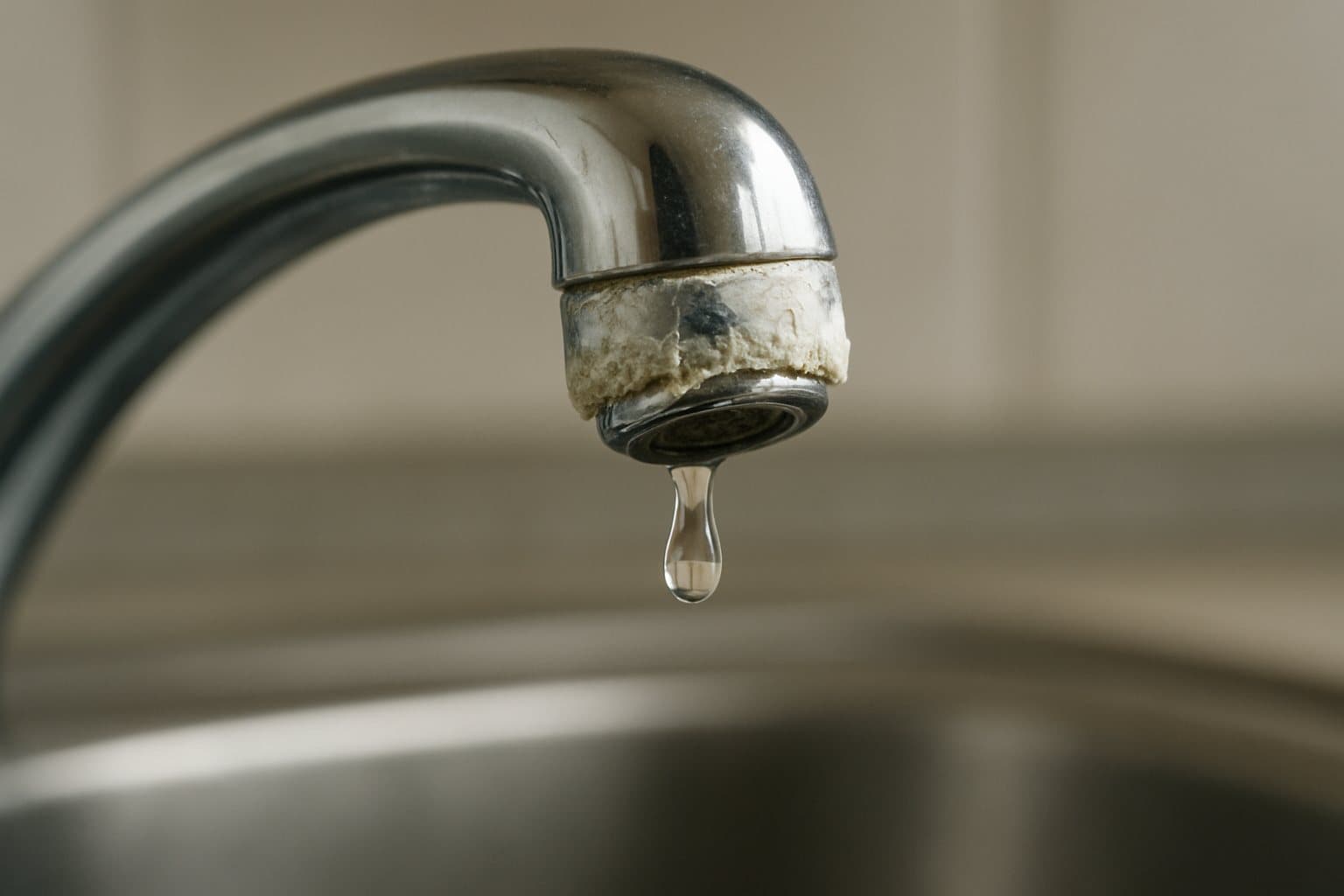
- You see scale that matches. White crust on faucet aerators and shower heads, or scale building up in the water heater.
- You want fully soft water anyway. NSF/ANSI 44, the softener standard, treats water under 1 grain per gallon as soft (as summarised by WQA). Water at 2 to 3 gpg is soft by USGS terms but not by that one. Some people notice the difference in lather and on glass shower doors. That is a legitimate preference, and a salt-based softener is the whole-house equipment built to remove those minerals rather than disguise them. Our salt versus salt-free explainer covers why.
When is a softener the wrong fix?
A softener is the wrong fix when the complaint is taste, smell or staining that hardness does not cause. It swaps calcium and magnesium for sodium and does nothing else. On soft city water, two other causes are more likely: chlorine, and corrosive water. Neither responds to a softener.
Chlorine taste or a pool smell. MAWSS reports a chlorine residual of up to 2 ppm in its 2025 report. That is well within the legal limit of 4, but noticeable. The fix for that is carbon filtration, not softening.
Blue-green stains. MAWSS lists its corrosivity (saturation index) between -1.54 and -1.19 and runs a corrosion-control program. A negative index means the water tends to dissolve rather than deposit minerals. That is the opposite of a scale problem, and blue-green stains from copper pipes are a separate diagnosis.
Cloudy glasses. Mineral spotting is a hardness symptom, but cloudiness on glassware washed in soft water can be etching instead. Etching is permanent, and it usually traces to very soft water plus too much detergent, so a softener would not help. A glass that comes clear after a vinegar soak had mineral spots; one that stays cloudy is etched.
How do you find your own hardness number?
Read your utility's annual report, use a test strip at the tap, or book a free in-home screen. Any of the three tells you whether your water is soft or hard, and that is the question that decides whether a softener is worth buying. None of them costs much, and the report costs nothing at all.
- Read your utility's report. Every community system publishes one each year. Look for "Hardness" in the secondary or unregulated table and divide the mg/L figure by 17.1.
- Use a hardness test strip at the kitchen tap. Strips give a range, not a precise number, but a range is enough to tell soft from hard.
- Book the free in-home test. It is an on-site screen for hardness, chlorine, total dissolved solids and a soap test, with results while we are there.
Once you have a number, the hardness calculator converts ppm to grains and shows what size of softener that reading would call for, if it calls for one at all.
If you already own a softener
The same logic runs in reverse. A softener programmed for a generic hardness setting, rather than your real one, regenerates more often than it needs to and sends salt and water down the drain every time. Most valves regenerate overnight, which is why yours runs at 2am, so you may never notice how often it happens. If the salt disappears faster than seems right, the hardness setting is the first thing to check. Is your softener set for the wrong hardness? covers how to find it and what to enter.
The shortest route to an answer is a number. The free in-home test screens hardness, chlorine, TDS and a soap test at your tap. If it reads soft, you will see that on the spot.