

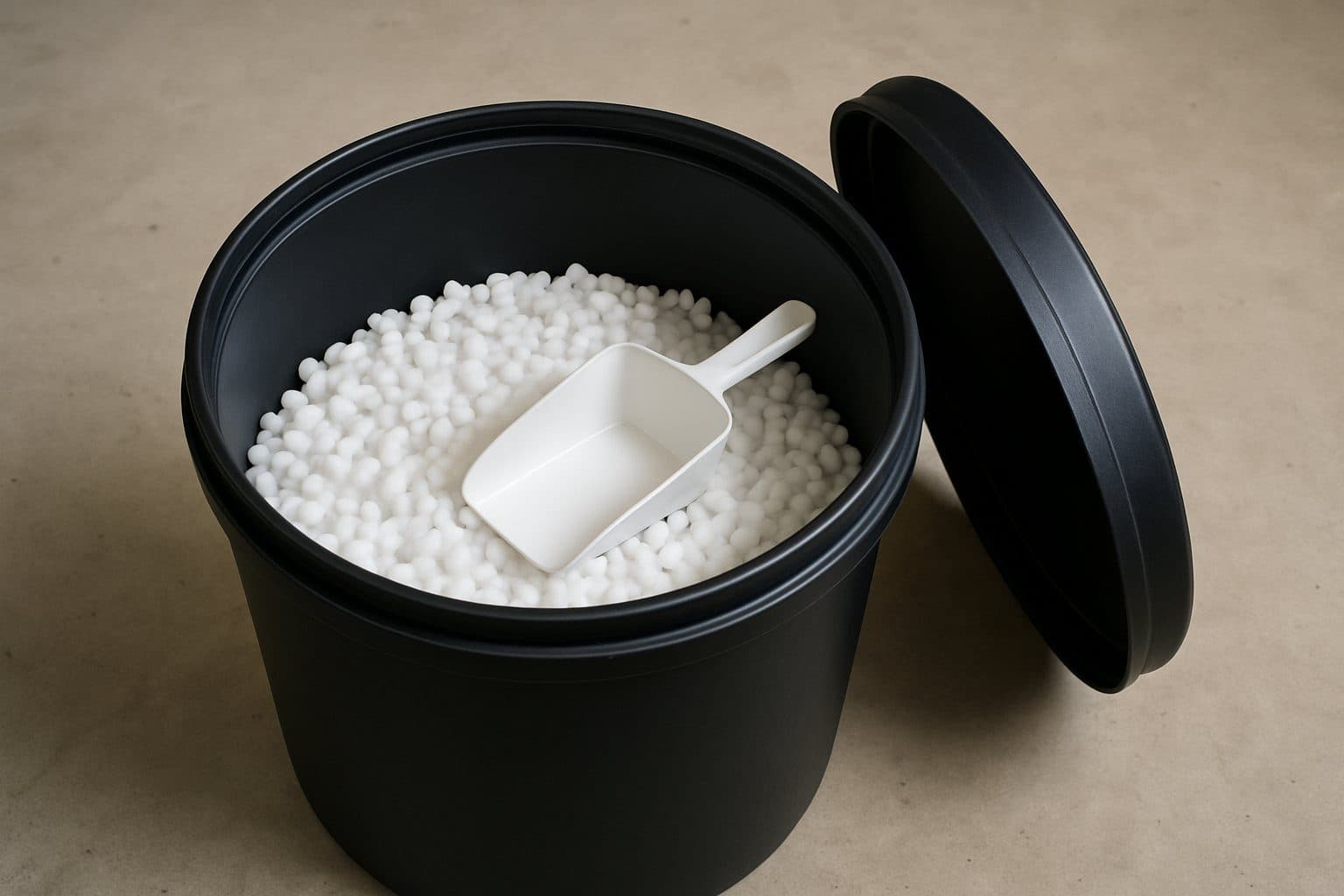
"How much salt should it use" has no single answer, and the range between correct answers is wide enough that comparing with a neighbour tells you nothing.
What actually drives consumption
Three things, multiplied together.
Hardness. Every grain removed consumes salt. Water at 12 grains per gallon costs roughly four times the salt of water at 3, for the same volume.
Water used. More gallons, more hardness removed, more regenerations. A household of five will not resemble a household of one.
How the valve is programmed. This is the variable people forget. A softener can be set to regenerate on a timer or by metered volume, and at a salt dose chosen per cycle. A timer-based unit regenerating every three days regardless of use burns salt on weeks nobody was home.
Metered regeneration is generally the better setting. It costs nothing to switch on most valves and it stops the unit working when there is nothing to do.
A practical routine
Check monthly. Top up when the level falls below about a third of the tank.
Do not fill to the brim. Two-thirds is a better maximum. A full tank makes a salt bridge more likely, and it hides the thing you most need to see — whether the level is moving.
Watch the trend, not the number. Consumption that is stable is fine at almost any level. Consumption that suddenly doubles means something changed: a running toilet, a leak, a valve stuck in regeneration, or a household change.
Consumption that stops entirely is the one that matters. A brine tank whose level has not moved in months is not being efficient — it is not regenerating.
More salt does not mean softer water
Once the resin bed is fully regenerated, additional salt does nothing. It exits in the discharge water without softening anything.
So a valve set to a higher salt dose than the resin requires costs money every cycle and delivers no improvement. If a unit seems to eat salt without a corresponding hardness or usage explanation, the setting is worth checking before the hardware is blamed.
Which salt
Pellets or solar crystals are the usual choice and both work well.
Rock salt is cheaper and carries more insoluble material, which settles in the bottom of the tank and eventually has to be cleaned out. That is a real cost that does not show on the receipt.
The more important rule is consistency. Mixing types — pellets on top of what is left of crystals — is a common cause of bridging, because the layers absorb moisture differently and crust at the boundary.
When salt use is the wrong question
If the water does not feel soft and the salt level is dropping normally, salt is not your problem. Something downstream of regeneration is failing, and the check that settles it is a hardness reading either side of the unit.
The free in-home test includes that reading, on any unit including one we did not install.