

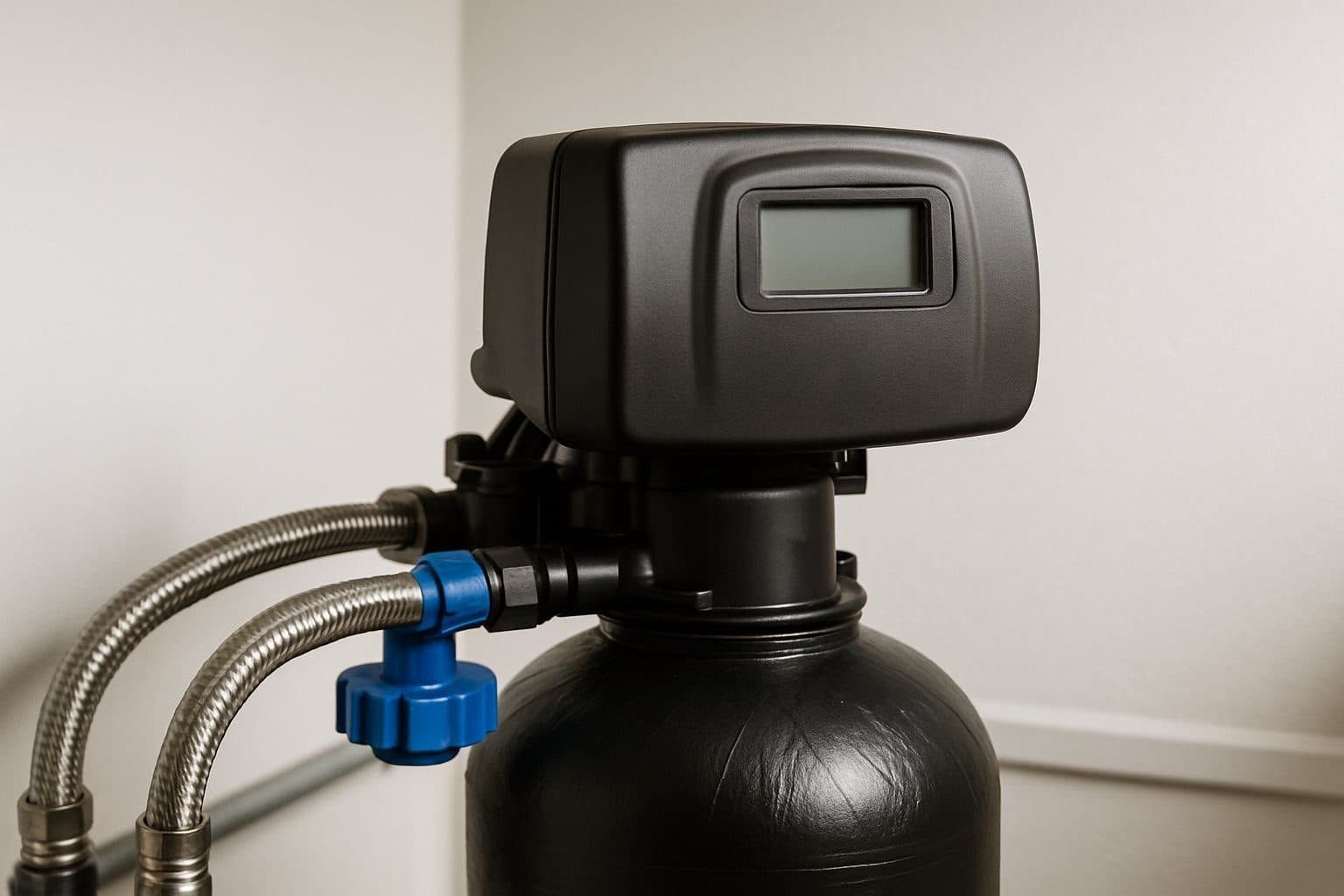
A failed water softener does not announce itself. There is no error light, no leak, no noise. It sits there looking exactly like a working one while the water going past it is unchanged.
Most people find out months later, indirectly, from soap.
The four checks
1. The salt level. This is the fastest and the most diagnostic.
A working softener consumes salt every time it regenerates. If the level in the brine tank has not moved in months, it is not regenerating — and a softener that does not regenerate is a pipe with a tank next to it.
People often read a permanently full tank as a good sign. It is the opposite.
2. Push a broom handle into the salt.
Salt can form a bridge — a hard crust spanning the tank with an air gap underneath. The top looks full; the water below cannot reach any salt; no brine gets made. Push a handle down through the salt. If it hits a crust and then breaks through into a void, you have found it. Break the crust up and the unit often starts working again the same week.
3. Soap and glassware.
This is the symptom most people notice first without connecting it. Soap that stops lathering the way it used to, shampoo that seems to do less, spotting on glasses out of the dishwasher that was not there last year. Softened water lathers easily; hard water does not.
The change is gradual, which is exactly why it takes months to register.
4. A hardness reading either side of the unit.
The only definitive check. Water in, water out. If the numbers are the same, the softener is doing nothing regardless of how it looks or sounds.
What usually breaks
The control valve, more often than anything else. It is the part with moving components and electronics, and it is what decides when regeneration happens. A valve that has lost its schedule leaves everything else in perfect condition and still delivers hard water.
Resin degrades slowly and lasts a long time under normal conditions. It can be fouled early by iron or by chlorine on city water, which is a reason to know what is upstream of it.
The brine line or injector can clog, so the unit runs its cycle on schedule and simply does not draw brine. From outside, that looks identical to working.
Before you accept a replacement quote
Run the four checks first. A bridged salt tank is a broom-handle fix and gets quoted as a new system more often than it should.
If the unit is genuinely done, that is worth knowing too — but the sequence matters: diagnose, then decide. Any quote that arrives before someone has taken a hardness reading either side of the unit was written without the one piece of information that settles it.
We will take that reading as part of a free in-home test, including on a system we did not install, and tell you if the answer is that nothing needs doing.
General guidance rather than a diagnosis of a specific unit. Follow your manufacturer's instructions for maintenance, and disconnect power before opening any control housing.