

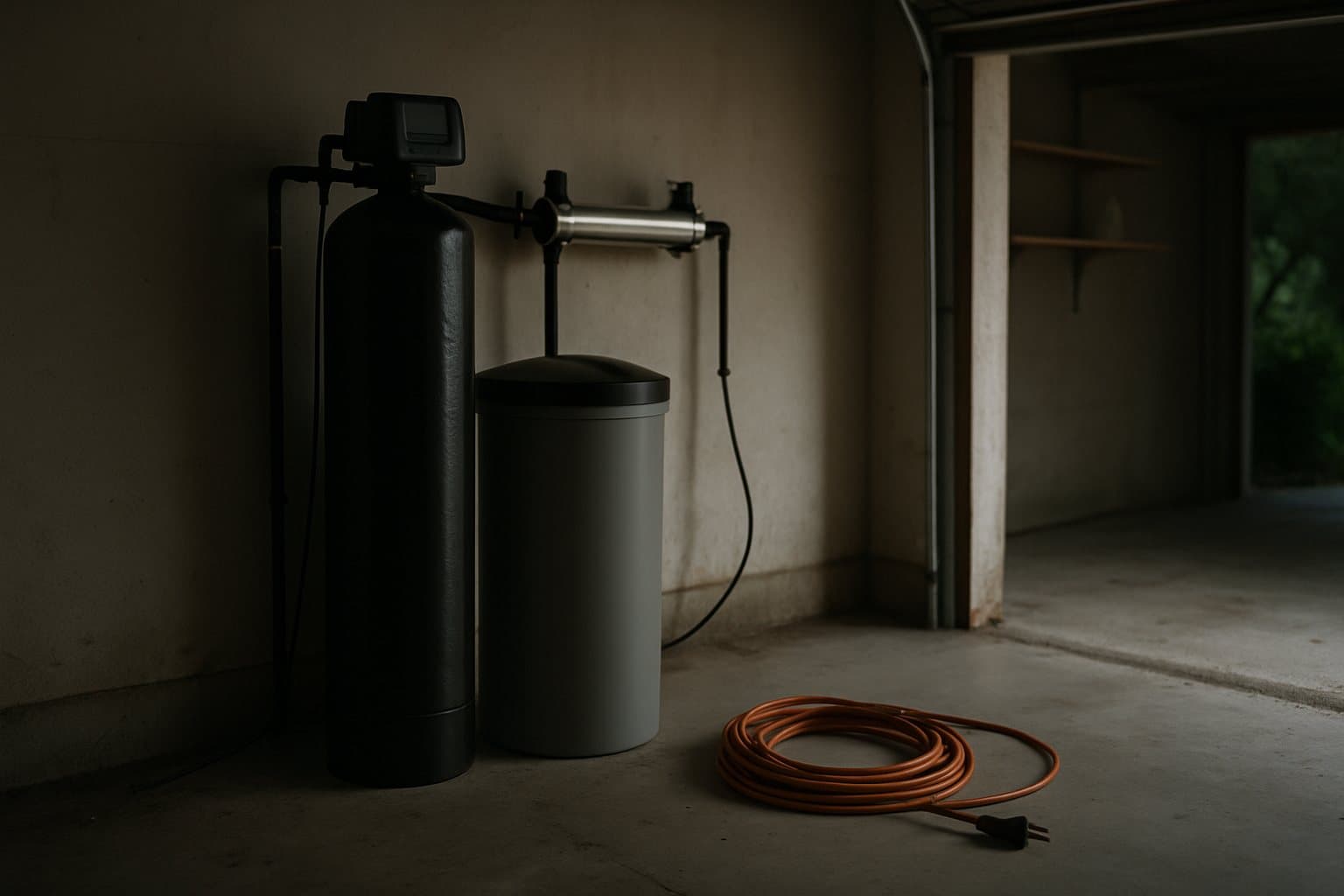
A softener mostly keeps working through a power outage. The resin still softens, but the control stops counting water and won't regenerate until power returns. A UV system is different: with the lamp off it disinfects nothing, and any water that passed through it while it was off needs dealing with. After a multi-day outage, the softener needs a check and the UV needs a restart procedure.
Hurricane season is when this comes up here, and it tends to come up alongside a boil-water notice or a flooded yard. Taking each piece of equipment in turn, this post covers what the outage did to it and the checks to run once the lights come back.
If you'd rather someone else ran these checks on a schedule, before a storm tests them, that's what our water system maintenance plan is for.
What does a power outage do to a water softener?
It interrupts the control, not the softening. Ion exchange works without electricity, so water flowing through the resin tank still gets softened. The control head is what stops. It loses track of how much water you use, it can't start a regeneration, and if the power failed mid-cycle, the valve stays exactly where it was.
We'll use the Fleck 7000SXT as the example, because it is a very common control valve and its service manual is specific about power failure. According to the manual, when the power goes:
- The control drops into a power-saving mode. The display and motor shut down.
- It stops monitoring water usage, but it stores the volume remaining at the moment of the power failure.
- It keeps time and the day count for at least 48 hours on its internal backup.
- Your settings are held in non-volatile memory, so they survive any length of outage.
- If the power failed during a regeneration, the valve stays in its current position until power returns, then picks up the cycle from where it stopped.
- If the outage caused it to miss a scheduled regeneration, it queues one and runs it the next time the clock reaches the programmed regeneration time. The manual says this usually means regenerating a day late.
Other brands handle this differently, so check the manual for your valve. What they all share is that the softener isn't counting while the power is off.
What should you check on a softener when the power comes back?
Check the clock, let any interrupted regeneration finish, and consider a manual regeneration if the outage was long or the water came under a boil-water notice. A softener that missed a regeneration and wasn't counting water may be closer to exhausted than its display suggests.
- Look at the display. On the 7000SXT a flashing time of day means there's been a power failure, and pressing any button stops it. After more than about 48 hours without power the clock may have drifted, so set it again. Softeners regenerate at a set time of day, usually overnight, and a wrong clock moves that into the morning shower. (That overnight timing is deliberate. We explain why in why your softener runs at 2am.)
- If it was mid-regeneration, let it finish. The valve resumes on its own. The manual notes that a softener should have the safety components needed to prevent an overflow if the power fails during regeneration, so look around the brine tank and drain line for water where it shouldn't be.
- Regenerate manually if in doubt. Water used during the outage wasn't counted, and a missed regeneration runs a day late. On a 7000SXT, holding the Extra Cycle button for five seconds starts a regeneration straight away. If your utility issued a boil-water notice, the CDC's checklist for when it lifts includes running the softener through a regeneration cycle anyway.
- Check the salt. A regeneration draws on the brine tank, so make sure there's salt in it.
- Watch for the usual signs over the next few days: spots on glasses, soap that won't lather. If they turn up, go through how to tell if your softener has quietly stopped.
If the softener itself sat in flood water, that's a different job and it shouldn't go back in service without being checked. That belongs to post-storm response rather than a reset.
What does a power outage do to a UV system?
It turns the disinfection off. A UV system only works while the lamp is lit, so any water that moves through the chamber during an outage passes through untreated, and any bacteria in it can reach the plumbing downstream. After power comes back the lamp also needs a few minutes before it delivers its full dose.
On a private well you'd expect no water at all during an outage, because the pump needs power too. That holds until a generator comes out.
The generator trap. If the generator runs the well pump but not the UV unit, the house gets raw well water through a dark chamber. Put the UV controller on the same generator circuit as the pump, and have an electrician set up the generator connection. That also covers the carbon monoxide rule ADPH repeats after every storm: generators stay outdoors, at least 20 feet from doors, windows and vents, per its storm guidance.
What should you check on a UV system after the power comes back?
Give the lamp time to warm up before anyone uses water. Confirm the controller shows no alarm. Then clean the plumbing after the UV unit, following your manufacturer's procedure. That last step exists because untreated water may have reached the pipes while the lamp was off.
VIQUA's owner's manual for its residential and PRO series spells out all three:
- Five minutes before use. "Do not pass water through the UV system for a minimum of 5 minutes after applying power (including after power interruptions)", to avoid passing under-treated water.
- Clean the downstream plumbing. The manual calls for the plumbing after the UV unit to be chemically cleaned after installation, and again "whenever the UV is shut down for service, without power, or inoperative for any reason." It then describes the procedure.
- Protect the controller. It strongly recommends a UL 1449-certified (or equivalent) transient voltage surge suppressor for the controller. That's worth having in a place where storms come with power surges and generator changeovers.
Then look at the controller. The lamp should be on and there should be no alarm. If the unit was flooded, or the alarm won't clear, it needs an inspection before you trust it. A UV lamp can also keep glowing after its output has dropped below a disinfecting dose, which is a separate problem from the outage. We cover it in why a UV lamp needs replacing at 9,000 hours.
If your well is on UV and you want to know whether the system is sized and protected properly for storm season, start with our UV disinfection page. It explains what we install and what water UV needs upstream of it.
Softener and UV: the side-by-side
| Water softener | UV system | |
|---|---|---|
| During the outage | Resin still softens. Control stops counting and can't regenerate | No disinfection at all |
| Risk while off | Resin may run past capacity without regenerating | Untreated water can reach the plumbing |
| First check after power returns | Clock, then any interrupted regeneration | Wait 5 minutes, confirm no alarm |
| Follow-up | Manual regeneration, salt level | Clean the downstream plumbing per the manual |
Checks on your calendar, not ours
None of this is difficult, but it lands on you in the same week as everything else a storm brings. Our maintenance plan puts regular checks on the equipment on our schedule, so problems get caught at a routine visit rather than after an outage. At $34.95/month it also carries our lifetime labor warranty, which stays in force for as long as the plan is active.
If the storm has passed and you want to know where your water stands, book the free in-home water test. It's a screen for hardness, chlorine, total dissolved solids and a soap test, read at your tap. A hardness reading will show whether a softener is actually doing its job. If you're on a well and need to know whether the water is safe to drink, that question goes to your county health department or a state-certified laboratory.
Procedures here are from the named manufacturers' manuals. Your equipment's own manual takes precedence.