

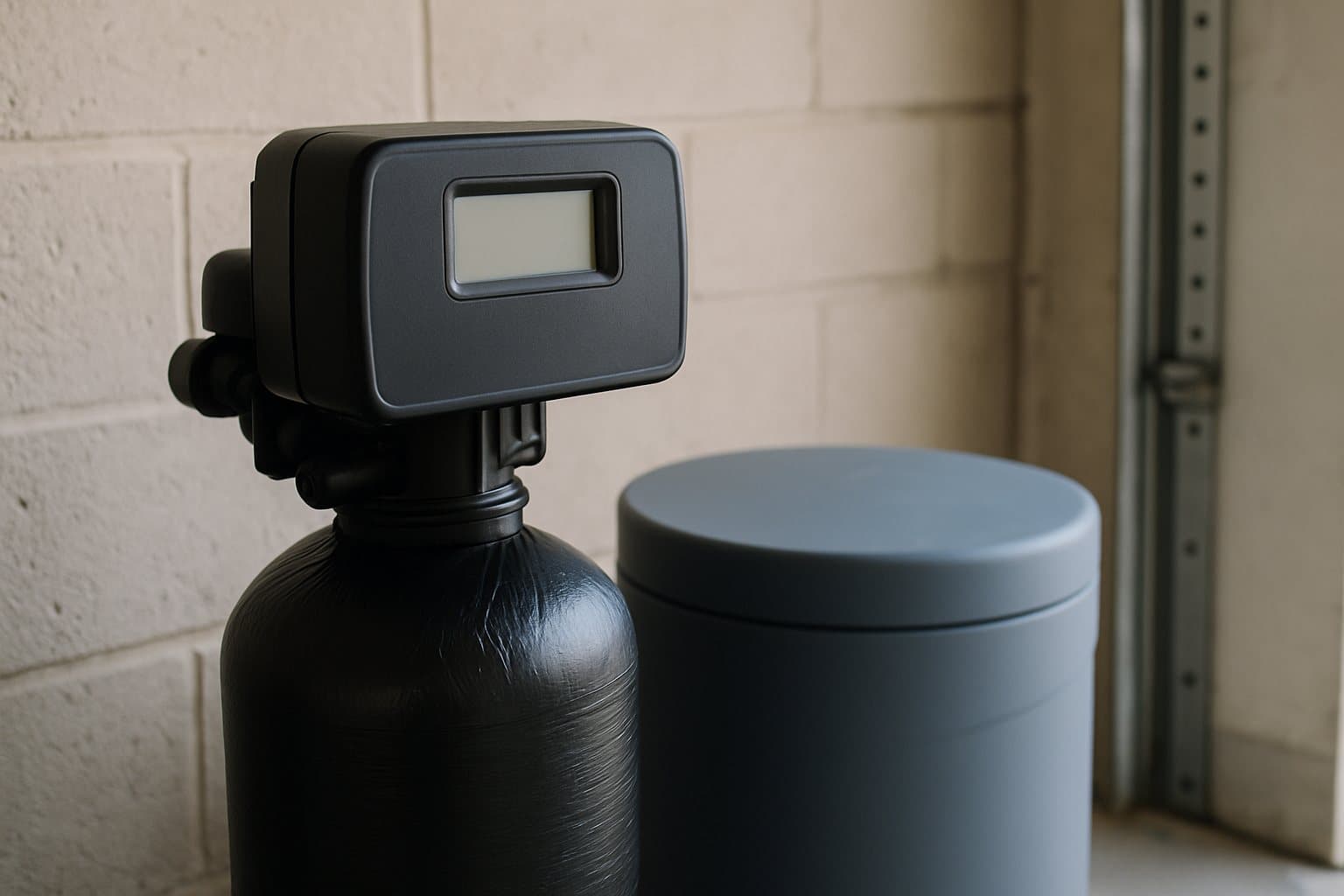
Every metered softener makes one calculation over and over, and the number it leans on is the hardness setting. That setting is typed in by hand at install. Nothing checks it afterwards. If it was guessed, the softener has been working from that guess ever since.
What should my water softener hardness be set at?
Set it to the measured hardness of the water entering the softener, in grains per gallon. Use the top of the range if your supply varies, and add an allowance for iron and manganese where the manufacturer's manual calls for one. It should not be a factory default, a round number, or a figure from another house.
The manual for the system we install puts it the same way. Hydrotech's 89UF owner's manual tells the installer to "program the date, the time of day, and the correct hardness setting." It also notes that the installer usually sets it for the worst case where hardness fluctuates.
If you would rather not track this yourself, the maintenance plan is $34.95 a month and includes twice-yearly maintenance visits. A visit is a natural time to compare the setting on the valve with a fresh reading.
Why does the hardness setting matter so much?
It sets how many gallons the softener treats before it regenerates. A metered valve divides its capacity by the hardness setting, so an inflated number triggers regenerations the water did not need. Each one uses salt and sends water to the drain. A number set too low lets hard water through before the valve regenerates.
Pentair's Fleck 5600SXT system manual describes the calculation plainly. The control finds the system capacity "by dividing the unit capacity ... by the feedwater hardness and subtracting the reserve."
Here is what that does to a single softener. Take an illustrative unit with 24,000 grains of usable capacity in a house using 300 gallons a day, which is EPA WaterSense's figure for the average American family at home:
| Hardness setting | Gallons between regenerations | Days between regenerations |
|---|---|---|
| 20 gpg | 1,200 | 4 |
| 10 gpg | 2,400 | 8 |
| 3 gpg | 8,000 | About 27 |
The water is the same in all three rows. Only the number on the valve changes. If your water really is around 3 gpg and the valve says 20, it regenerates about seven times as often as it needs to.
Two things temper that example:
- Many valves have a day override. They also regenerate after a set number of days even if the metered capacity is not used up, so a soft-water house may never reach 27 days. The Pentair manual calls this the regeneration day override.
- The salt dose per regeneration is its own setting. How much salt each cycle uses is programmed separately, which is why how much salt a softener should use has no single answer.
Regeneration is not free. EPA's WaterSense page on cation exchange softeners notes that regeneration can use up to 10,000 gallons of water a year. Unnecessary regenerations are a direct share of that.
Why does this come up in Mobile and Baldwin County?
Because the published water here tests low, any number picked to be "safe" for hard water overshoots it by a wide margin. The gap between a guess and the real reading is larger here than in a hard-water region, so a guessed setting costs more salt and water than it would elsewhere.
| Source | Hardness |
|---|---|
| MAWSS 2025 water quality report | 38.3–49.6 mg/L, about 2.2–2.9 gpg |
| Daphne Utilities 2026 report (2025 testing) | 15.3–27.6 mg/L, about 0.9–1.6 gpg |
| USGS/EPA Water Quality Portal, 2020–2025 | Median about 1.9 gpg across 42 Mobile County sites and 1.2 gpg across 47 Baldwin County sites |
Those are published figures, not a reading of your house. A private well can sit far from any median. That is exactly why the setting should come from a test at your property.
How do I find my softener's current hardness setting?
It is almost always in the valve's menu or programming mode, labelled "Hardness" and shown in grains per gallon. Write the number down before changing anything, and check your owner's manual for the button sequence. If the manual is long gone, the valve's make and model are printed on it, and most makers publish manuals online.
On the Hydrotech 89 series valve, Hardness appears in the main menu. On a Fleck SXT control it is the Feed Water Hardness setting, shown as "H" in master programming. While you are in the menu, also check:
- Whether it regenerates by meter or by timer. A timer regenerates on a schedule whatever the hardness setting says. A meter uses the calculation above.
- The regeneration time. Most valves ship set to the small hours. Hydrotech's factory default is 2:00 a.m., which is why your softener runs at 2am.
How do I get the right number?
Test the water before it reaches the softener, convert the result to grains per gallon, and add any allowance the manufacturer specifies for iron and manganese. Use the high end if your supply varies through the year. That figure, and not a round number, is what goes into the valve.
- Test untreated water. Use a tap that bypasses the softener, or put the softener in bypass for the test. Testing softened water and entering that number is the classic mistake.
- Convert if needed. Reports often give mg/L or ppm. Divide by 17.1 for grains per gallon, or use the hardness calculator.
- Add iron and manganese if your manual says to. The Hydrotech manual's compensated-hardness method adds 4 gpg for every ppm of iron and 8 gpg for every ppm of manganese. Our free screen does not read iron or manganese. If you need those numbers, use a state-certified laboratory.
- Use the high end of a range. City water varies through the year, and the manual's worst-case guidance exists for that reason.
What are the signs the setting is wrong?
The valve will not flag its own setting. The clues show up in two places: how fast the salt goes down, and how the water behaves toward the end of each cycle. A setting too high burns salt; a setting too low lets hardness through before the next regeneration.
- Salt vanishing faster than your household explains, with regenerations most nights, points to a setting that is too high.
- Hardness symptoms that come and go, such as spotting or poor lather near the end of a cycle, point to a setting that is too low.
- Hard water all the time, with the salt level never moving, is not a setting problem. The softener is not regenerating at all, and the four checks for a softener that has stopped will find it.
For owners who want someone else looking after it, the lifetime labor warranty comes with the $34.95/month maintenance plan. Installs without the plan carry our standard 1-year parts and labor warranty.
The number that matters is the one at your tap. The free in-home test screens hardness, chlorine, TDS and a soap test on any softener, including one we did not install.