

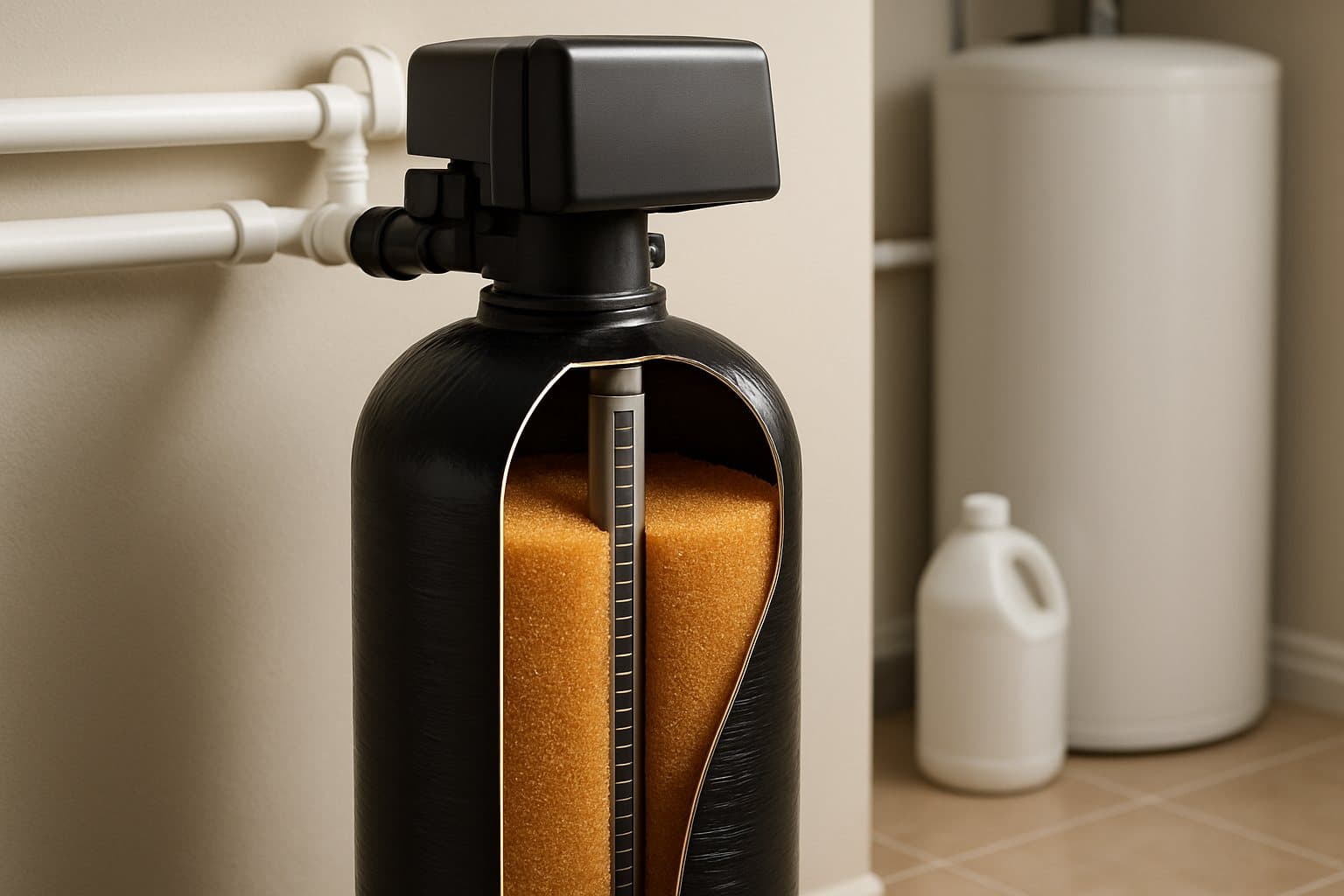
Resin is the part of a softener that does the work, and it is rarely the part that fails. Understanding why matters, because "you need new resin" is a common diagnosis and often the wrong one.
What it actually does
The tank is full of small plastic beads carrying sodium ions on their surfaces. Hard water passes through; calcium and magnesium have a stronger affinity for the resin than sodium does, so they swap places. Hardness stays on the bead, sodium goes into the water.
The bed fills up. Regeneration floods it with concentrated brine, sheer sodium concentration reverses the exchange, and the accumulated hardness flushes to the drain.
That cycle can run thousands of times. Resin is not a consumable in the way a filter cartridge is.
What actually kills it early
Iron fouling. This is the big one locally. Dissolved iron entering a softener can oxidise and precipitate inside the bed, coating the beads in a layer that blocks exchange sites. Capacity falls and no amount of salt recovers it, because the problem is a physical coating rather than a loaded bed.
It matters here because USGS sampling finds 70% of Mobile County and 76% of Baldwin County groundwater sites above the iron secondary standard. A softener installed on a well without knowing the iron number is running a real risk — and dedicated iron treatment is not something we install, which is precisely why we want that number before quoting anything.
Chlorine. On city water, chlorine gradually attacks the resin's cross-linked structure. The beads soften, swell, and lose capacity — and unlike iron fouling this is not a coating that can be cleaned off. It is structural.
The prevention is a carbon stage upstream of the softener, which also happens to improve the water in every other way.
Physical loss. Beads escaping through a damaged distributor or screen. The usual symptom is resin appearing somewhere it should not be, including in faucet aerators.
Cleaning versus replacing
Resin cleaners exist and work on iron fouling specifically, particularly if caught before the coating is severe. They can restore useful capacity.
They do not reverse chlorine degradation, because that is the bead structure breaking down rather than something sitting on it.
And neither addresses the cause. Cleaning fouled resin on a well that is still delivering iron buys time, not a fix.
Diagnosing in the right order
Resin should be the last suspect, not the first:
- Is it regenerating at all? A brine level that never drops answers this.
- Is it drawing brine? A cycle can run on schedule and fail to draw, which looks identical from outside.
- Is the valve programmed sensibly? Timer versus metered, and the salt dose.
- Then consider the bed.
Skipping to step four is how a bridged salt tank becomes a quote for a new system.
The four checks in order, or book the free test — it includes a hardness reading either side of the unit, which is the measurement that actually settles it.