

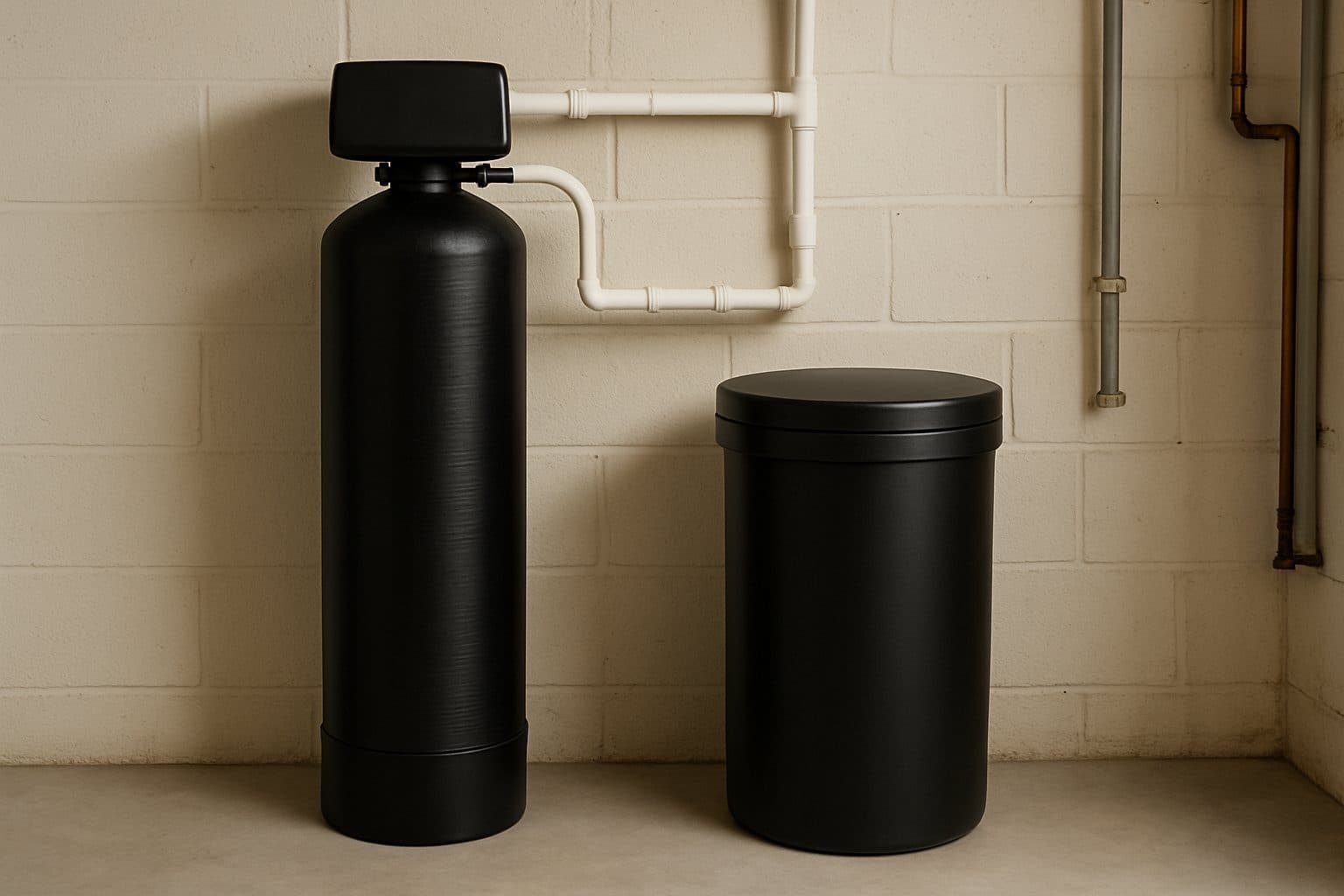
Two products get sold as if they do the same job. They do not, and the difference is worth understanding before anyone quotes you either one.
What a salt-based softener actually does
A salt water system softens hard water by replacing calcium and magnesium with sodium.
That sentence is the whole mechanism. Hard water arrives carrying dissolved calcium and magnesium. Inside the softener is a bed of resin beads holding sodium ions. As water passes through, the calcium and magnesium trade places with the sodium — they bind to the resin, the sodium goes into the water, and what leaves the tank has measurably less hardness than what entered.
The word that matters is replacing. The hardness minerals are physically removed from the water and flushed out during regeneration. Test the water afterwards and the grains-per-gallon reading drops, because there is genuinely less mineral in it.
What a salt-free conditioner actually does
Salt-free does not remove hardness minerals. It crystallizes them so they do not stick to pipes or appliances.
Nothing is taken out. The calcium and magnesium are still dissolved in the water when it reaches your tap, and a hardness test will read essentially the same before and after. What changes is the form — the process encourages the minerals to form stable crystals that are less inclined to bond to hot metal surfaces, so less scale accumulates.
That is a real effect, and for some households it is enough. But it is a different claim from softening, and the two get blurred in marketing.
The distinction in one line
A softener changes what is in the water. A conditioner changes how what is in the water behaves.
Everything else follows from that:
- Hardness test after treatment — softener: lower. Conditioner: unchanged.
- Soap and detergent — softener: lathers properly, less product needed. Conditioner: much as before, because lathering is suppressed by the minerals themselves.
- The slippery feel — softener: yes, that is soap working correctly. Conditioner: no.
- Spotting on glassware — softener: largely resolved. Conditioner: often persists, since the minerals are still present to dry onto the surface.
- Scale in the water heater — both help. The softener addresses the cause; the conditioner addresses the adhesion.
- Salt and drain — softener: needs salt and a drain line for regeneration. Conditioner: neither.
Which one is right
If the complaint is scale in a water heater and nothing else, a conditioner can be a reasonable fit — no salt to carry, no drain to plumb, no regeneration cycle.
If the complaint is anything you can see or feel — spotting, dull laundry, soap that will not lather, film on shower glass — a conditioner will disappoint, because those symptoms are caused by the minerals being there, and a conditioner leaves them there.
On the Gulf Coast the second list is what people actually describe when they call. That is the honest reason we install salt-based systems.
What we install, and what we do not
We install salt-based softeners. We do not sell or service salt-free conditioners — so this page is not a sales comparison, it is the answer we would give you on the phone.
If you want to know which one your house actually needs, the useful first step is a number rather than an opinion: our free in-home test measures hardness, total dissolved solids, and chlorine, with results while we are standing there. Once you know your grains per gallon, the choice usually makes itself.