

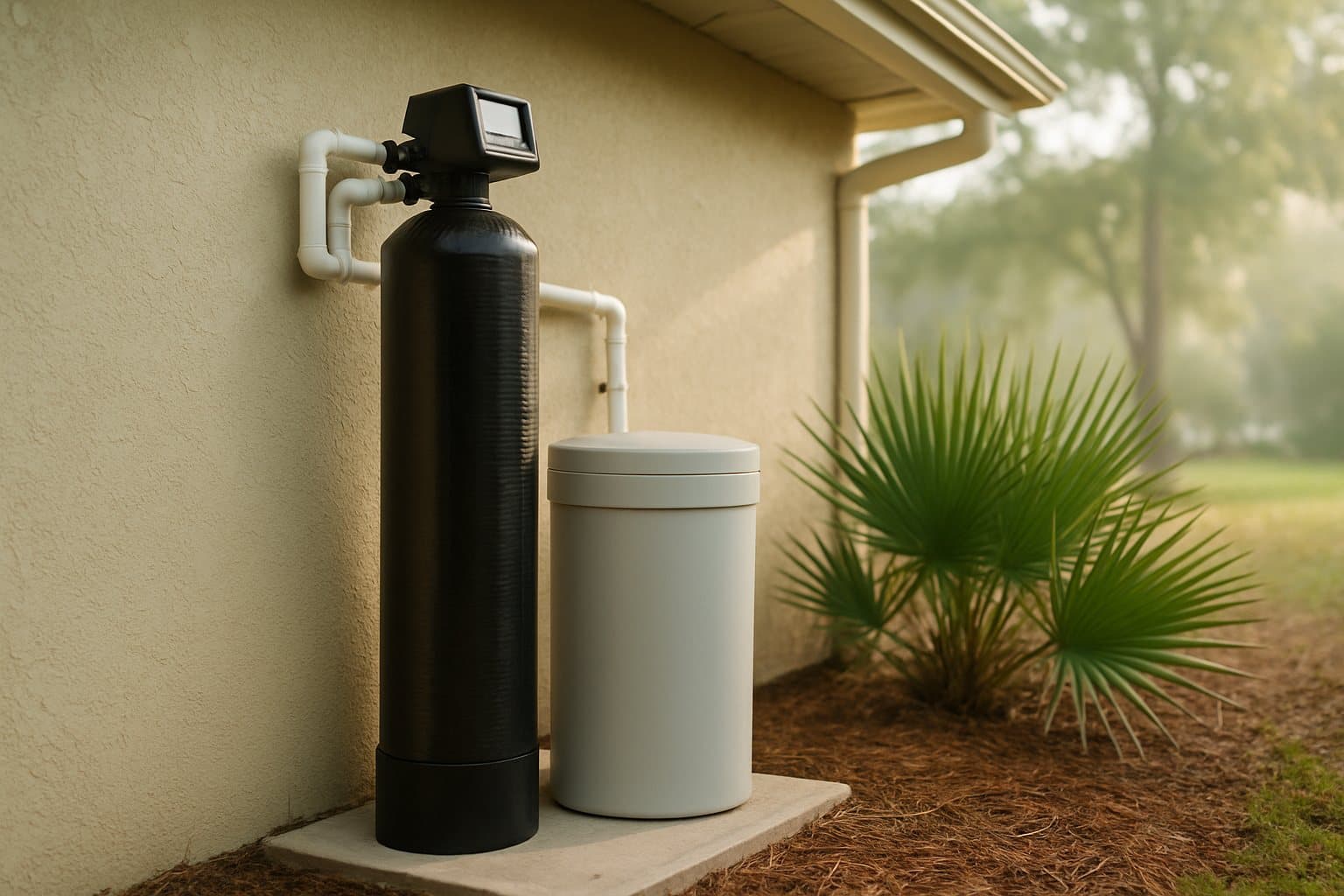
On a slab-built house with the main line coming up outside, putting the softener next to it is tempting. Before you do, read what the manufacturers say, and look at what the January 2025 freeze and Hurricane Sally did here.
Is it better to install a water softener inside or outside?
Inside, wherever the plumbing allows. Softener makers design their equipment for dry, sheltered spots and warn against freezing and direct sun. On the Gulf Coast that usually means a garage or utility room close to where the main line enters. Outdoors is possible, but only with real protection from freezing, sun, spray and flood water.
Placement is one of the first decisions in any water softener installation. It is worth getting right, because moving a softener later means re-plumbing the main line, the drain and the power.
What do the manufacturers say?
Both makers below plan for an indoor install, and both treat outdoor placement as a set of risks to manage. The warnings are almost the same: keep it from freezing, keep it out of direct sun, and keep water spray off the electronics.
| Hydrotech 89UF (the system we install) | Pentair Fleck 5600SXT | |
|---|---|---|
| Source | 89UF owner's manual | 5600SXT softener system manual |
| Operating range | 40°F to 110°F | Hot or cold extremes "may cause damage to the valve or controller" |
| Freezing | Do not install where freezing occurs; "will void the factory warranty" | Freezing "will cause physical damage to the internal parts as well as the plumbing" |
| Sun | "Keep the conditioner out of direct sunlight" | Materials fade over time; not expected to cause failure |
| Moisture | Not specified in the owner's manual | Valve rated NEMA 3; not built for "upwards spray from sprinkler" or constant heavy mist |
| Overall | Written for an indoor location | "It is recommended that the system be installed indoors" |
Pentair's manual adds one more line that matters outdoors. The valve and control "are for dry location use only unless used with a Listed Class 2 power supply suitable for outdoor use."
Does it really get cold enough to matter here?
Yes, occasionally, and occasionally is enough. The National Weather Service recorded 6°F at Mobile on January 22, 2025, tying for the third-coldest low on record. A softener only has to freeze once to crack a valve body or split a fitting.
The NWS Mobile summary of that storm notes it was only the 11th time Mobile had recorded a single-digit low. That rarity is the trap. It is easy to plan as if freezing never happens here, and the brine line, drain line and valve are all small-bore and full of water.
Timing makes it worse. Most softeners regenerate in the small hours, which is why your softener runs at 2am. On a freezing night that puts water moving through the brine and drain lines in the coldest hours.
What about heat, sun and sprinklers?
Summer is the more routine threat. Hydrotech's stated operating range tops out at 110°F, and a unit on a sun-facing wall in August sits in direct sun for hours. Irrigation is the other risk: Pentair specifically names upward sprinkler spray as something the valve is not designed to withstand.
A few practical points follow from the manuals:
- Shade matters. Hydrotech says to keep the unit out of direct sunlight outright.
- Watch the sprinkler heads. A rotor that sweeps across the valve every morning is exactly the spray from below that Pentair warns about.
- Insects. Pentair notes its controller keeps out "all but the smallest insects," which is a reason to keep the enclosure closed.
Where does flood and surge risk come in?
On the lower-lying parts of both counties, a softener at ground level sits where storm surge and flood water go. FEMA's flood maps put the city centres of Gulf Shores and Bayou La Batre inside the Special Flood Hazard Area. Hurricane Sally pushed surge well above ground level along the Baldwin coast.
The specifics, with the caveat that one point never describes every lot:
- FEMA flood zones. A query of FEMA's National Flood Hazard Layer at the centre point of Gulf Shores returns Zone AE with a base flood elevation of 13 feet. At Bayou La Batre it returns Zone AE at 15 feet. Your own address is what counts, and the FEMA Flood Map Service Center will look it up.
- Hurricane Sally. The NWS Mobile Sally summary records landfall at Gulf Shores on September 16, 2020, as a Category 2 storm, with 7 to 9 feet of surge above ground level in the Orange Beach and Perdido Key area and 29.99 inches of rain at Orange Beach.
A control valve sitting near knee height on an outdoor slab is below that kind of water. Inside a garage it may still flood, but it is better protected from wind-driven rain and debris. After any storm that puts water around the unit, treat the softener as needing a check before you trust it. The same goes for power: electronic valves, including Hydrotech's digital valve, need electricity to run their schedule. What softeners and UV systems need after a power outage covers the restart.
If it has to go outside, what does it need?
Sometimes there is no indoor route to the main line. If the softener has to go outside, it needs protection on every front the manufacturers list: freezing, sun, spray and standing water. The drain and the power supply need the same care as the tanks, because they are just as exposed.
- A freeze-protected enclosure, with any exposed lines insulated. Hydrotech also asks that discharge lines exposed to freezing slope downward.
- Shade, from the enclosure or the building, not just a cover over the valve.
- Height above grade, on a pad rather than bare ground, clear of sprinkler spray.
- A drain with a proper air gap. Hydrotech's manual calls for an air gap of two pipe diameters. Never push the drain line straight into a drain.
- Outdoor-rated power. A standard adapter plugged into an outdoor outlet is not the same as the listed outdoor supply Pentair calls for.
- An accessible bypass valve, so the house keeps water if the softener has to come offline.
What decides where it goes in your house?
Four things, all from the installation section of Hydrotech's manual: the unit should be as close as possible to where the water supply enters, near a floor or laundry drain, near a 120-volt outlet, and ahead of the water heater. If it sits within 10 feet of the water heater, a check valve goes in.
The manual also says outside taps used for lawns and gardens should be isolated from the softened supply, and that a separate line may be needed. Whether the garden hose should get softened water is worth settling before the location is. The same question comes up if you are thinking about a dual-tank softener: the equipment is larger, but the placement rules are identical.
Placement is easier to judge standing in the garage than reading about it. The free in-home test screens your hardness, chlorine, TDS and a soap test at the tap, which also tells you whether a softener is worth placing at all.