

Bacteria in a private well is a real problem with a well-understood fix. Ultraviolet disinfection is that fix — it works, it is proven, and it does not put anything in your water.
For a large share of wells in Mobile and Baldwin County, it is still the wrong thing to install first. Here is the arithmetic behind that.
What the standard actually requires
UV systems for private wells are built and certified to NSF/ANSI 55. A Class A system is validated to deliver a dose of at least 40 mJ/cm² at its alarm set point, which is enough for the organisms a well is likely to carry.
The standard also requires manufacturers to state that these devices are only for water that meets, or has been pretreated to meet, all of the following:
| Parameter | Limit |
|---|---|
| Iron | under 0.3 ppm |
| Manganese | under 0.05 ppm |
| Hardness | under 7 grains per gallon |
| Tannins | under 0.1 mg/L |
| Turbidity | under 1 NTU |
| UV transmittance | above 75% |
That is not fine print. It is the condition under which the validated dose means anything.
The number that matters locally
USGS sampling across these two counties finds:
- Mobile County: 70% of sampled groundwater sites exceed the iron secondary standard, with a median of 0.409 mg/L
- Baldwin County: 76% exceed it
The iron secondary standard is 0.3 mg/L — the identical figure NSF/ANSI 55 sets as its pretreatment threshold. Those two numbers are the same number.
Which means that on roughly three out of four sampled wells around here, the water arrives at a UV unit already outside the range the unit is certified for.
Hardness, for once, is not the problem. Local medians run 1.9 grains per gallon in Mobile and lower in Baldwin, well inside the 7-grain ceiling.
Why iron specifically breaks UV
Two mechanisms, and the second is the dangerous one.
Absorption. Dissolved iron absorbs and scatters ultraviolet light. The lamp emits its rated output; less of it reaches the organisms. UV transmittance drops, and the delivered dose drops with it.
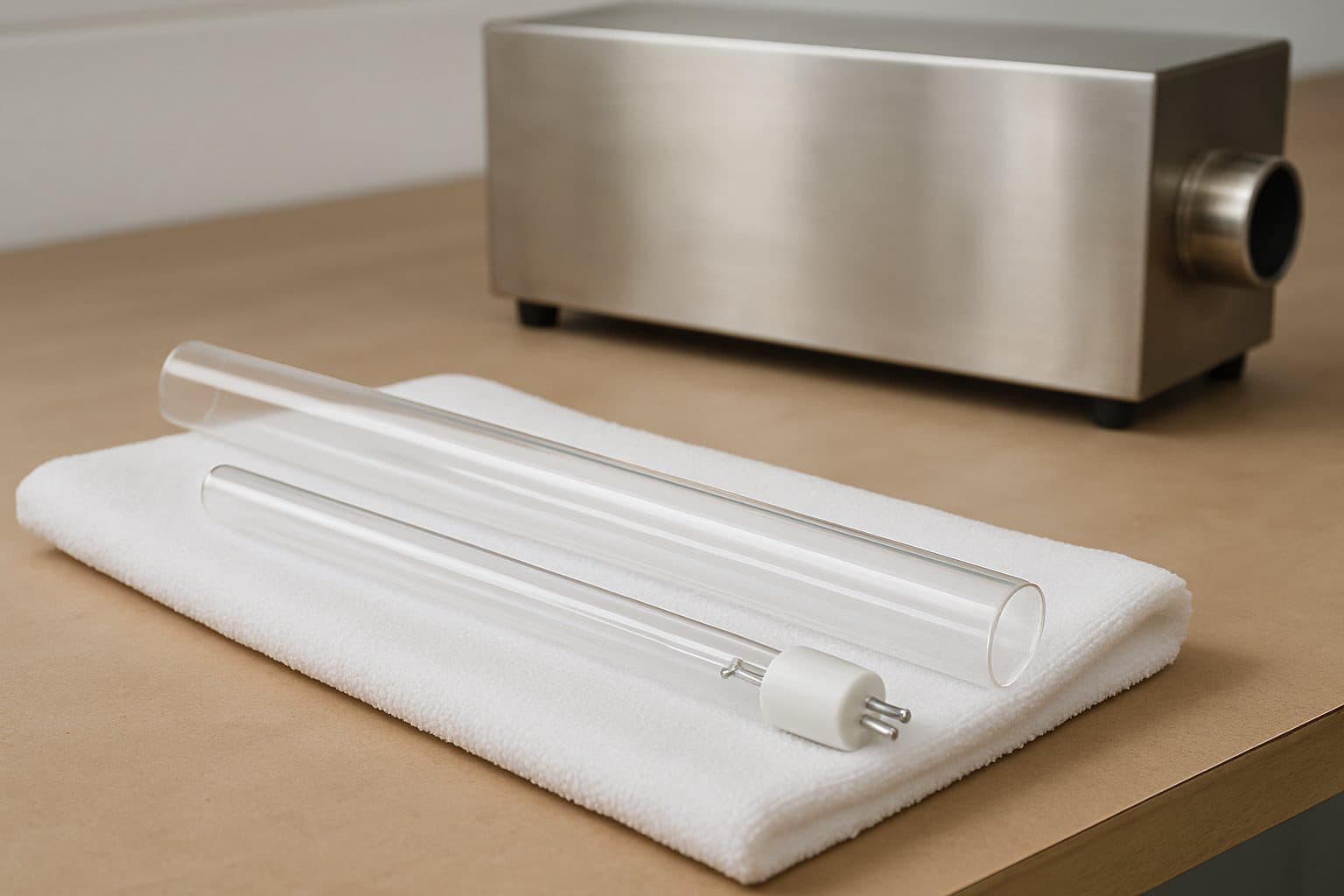
Fouling. Iron deposits on the quartz sleeve surrounding the lamp. The coating builds slowly, and as it thickens the effective dose falls — while the lamp still glows exactly as brightly as it did on the day it was installed.
That is the failure mode worth understanding. A fouled UV system looks identical to a working one. There is no leak, no noise, no change at the tap. The standard's answer is discipline: inspect and clean at least every three months, more often on known dirty or scaling water, and run a microbiological test kit at least once between lamp changes.
What this means if you are shopping
If someone quotes you a UV system for a well without asking for an iron number first, that is the question they skipped, and it is the one that decides whether the quote is any good.
The correct sequence is:
- Test. Iron, manganese, hardness, turbidity, pH.
- Pretreat if needed — upstream iron treatment by a company that specialises in it, where iron is the blocker.
- Then UV, sized to the flow and to water inside the certified envelope.
Installing step 3 without step 2 buys equipment that works on day one and quietly stops working, without telling you.
Where we stop
We do not install dedicated iron treatment. On a well where iron is what stands between you and effective UV, we cannot supply the pre-treatment our own UV service needs.
We would rather say that on a web page than at the end of a sales visit. If a test shows that is your situation, we will tell you and point you to someone who handles iron, and you can come back afterward — or not.
For everything else the water is doing, a free in-home test gives you the numbers this decision actually turns on.
Sources: NSF/ANSI 55 minimum requirements for Class A systems; USGS groundwater sampling for Mobile and Baldwin counties as compiled in this site's data layer (42 sites in Mobile); EPA secondary standard for iron. Verified 19 August 2026. County medians describe a region, not your well.