

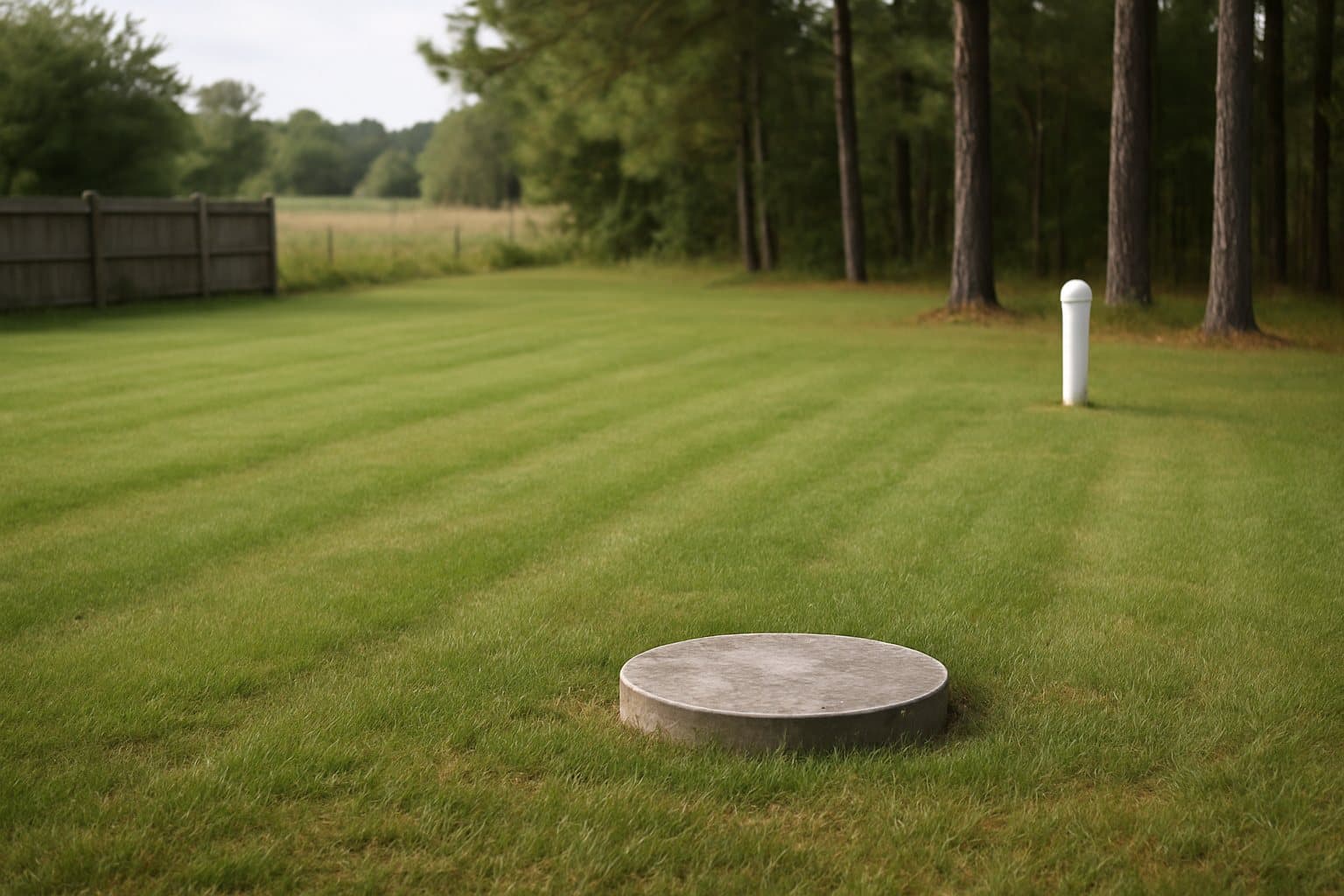
Most private wells in Mobile and Baldwin County share a lot with a septic system, sometimes the owner's own and sometimes the neighbour's. The two are designed to coexist. Trouble starts when the distance is too short, the ground is too permeable, or one of the two has stopped doing its job.
Can a septic tank contaminate well water?
Yes. A septic system that is failing, overloaded, or too close to a well can send bacteria, viruses and nitrate into the groundwater the well draws from. The risk rises when the well is shallow, the soil is sandy, the well sits downhill of the drain field, or the well casing or cap is damaged.
The US EPA's own explanation is plain about the mechanism. Wastewater leaves the tank, filters down through the soil beneath the drain field, and joins the groundwater. Soil removes most bacteria and viruses on the way. It does not remove everything, and groundwater flowing under a drain field carries what is left.
We design complete well water treatment systems, and we will say this up front: no treatment system should be the first response to a septic problem. The first response is finding out whether you have one.
How close can a septic system be to a well in Alabama?
Alabama sets two sets of numbers. ADPH's onsite sewage rules require a drain field at least 100 feet from a well and a septic tank at least 50 feet. ADEM's water well standards recommend 100 feet between a new well and a septic tank or field lines, and 150 feet from a lagoon or barnyard.
The two rules come at the problem from opposite ends. The health department's rule governs where a septic system may be installed relative to a well. ADEM's rule governs where a well should be drilled relative to everything else.
| From the well to... | Distance | Source |
|---|---|---|
| Septic drain field (EDF) | 100 ft minimum | ADPH, Table 4, Rule 420-3-1 |
| Septic tank, pump chamber or D-box | 50 ft minimum | ADPH, Table 4 |
| Septic tank or field lines | 100 ft recommended | ADEM, Rule 335-9-1-.04 |
| Cess pool or sewage lagoon | 150 ft recommended | ADEM, Rule 335-9-1-.04 |
| Barnyard | 150 ft recommended | ADEM, Rule 335-9-1-.04 |
Two things are worth knowing about that table. ADEM's figures are written as a recommendation, and the same rule says the well location "shall comply with local regulations," so your county health department has the final word. And EPA makes a point that applies directly to coastal Alabama: where soil is sandy or porous, you may want more distance than the minimum.
Older homes are the ones to check. The current version of the onsite sewage rules took effect in February 2023, and a house and well laid out decades earlier may not meet it.
What makes a well more likely to be affected?
EPA names the conditions that raise the risk: a shallow well in permeable soil, a well downhill of the septic system in the direction groundwater flows, many homes on septic around the well, and poor construction or upkeep of either the well or the septic system.
Several of those describe ordinary conditions here.
- Depth. USGS found the most common private-well depth in Baldwin County was about 100 feet (Open-File Report 96-487). There is more on what depth does and does not tell you.
- Permeable ground. The sand-and-gravel aquifer here moves water readily, and near the coast the water table sits close to the surface.
- Neighbours. In a subdivision where every lot has both a well and a septic system, your well sits in the path of more than one drain field.
- The wellhead itself. EPA notes that if untreated wastewater surfaces in the yard, it can reach the water through an unsecured well cap or a crack in the casing. That route bypasses the soil entirely.
What does septic contamination look like in a water test?
It usually shows up as bacteria, nitrate, or both. A positive total coliform or E. coli result says a pathway exists between the surface and your water. A nitrate level that is elevated or rising is the other signature of wastewater or fertilizer reaching the aquifer.
Neither is something you can see, smell or taste reliably, which is the whole problem. A well can produce clear, good-tasting water with a septic plume reaching it.
If you already have a result in hand, two posts go deeper:
- What total coliform versus E. coli means, and why the two carry different urgency
- Why nitrate is the result you act on immediately, especially with an infant in the house
One honest limit: our free in-home test is a screen for hardness, chlorine, total dissolved solids and a soap test. It does not detect bacteria or nitrate, and it is not the test to use for this question.
What should you do if you suspect your septic system?
Get the well tested for bacteria through your county health department, have the septic system inspected, and have the well casing and cap looked at. Stop drinking the water in the meantime if E. coli is found. Disinfection comes after the source is fixed, not instead of fixing it.
In practice, the order runs like this.
- Test through the health department. The Alabama Department of Public Health says to call your county health department, use one of its sample containers, and expect results about 24 hours after the lab receives the sample. A collection or testing fee may apply.
- Have the septic system inspected. EPA's guidance is that a household septic system should be inspected at least every three years and the tank is typically pumped every three to five years. A soggy or unusually green patch over the drain field, slow drains, or odours in the yard all justify an inspection sooner.
- Have the wellhead checked. Alabama's well construction rules require casing that extends at least a foot above ground and a cap that keeps contamination out. A licensed well driller can tell you whether yours still does.
- Disinfect only after the source is dealt with. ADPH publishes a homeowner procedure for chlorinating a well. Chlorinating a well that is still receiving wastewater buys a few clean weeks at best. We do not disinfect wells; that step belongs with the health department's guidance or a well contractor.
- Retest. One clean result after disinfection is a start. A well that keeps coming back positive is a different problem.
Where treatment fits, and where it does not
Treatment is for a source you cannot move. If the septic system is repaired, the well is sound, and the water still needs help, that is where ongoing equipment makes sense: UV disinfection as a standing guard against bacteria, or reverse osmosis at the kitchen tap where nitrate is the concern.
What treatment cannot do is make a failing drain field or a well 30 feet from it safe. If the setback is the problem, the fix is moving one of them, and that is a job for a septic installer or a well driller. We will tell you so rather than quote equipment that treats a symptom. More background on private wells in this part of Alabama is here.
If you are buying a house with both
A well and a septic system on the same lot is a question worth answering before closing, not after. Measure the distance, ask the seller for pumping and inspection records, and know that an FHA or VA loan brings its own water test requirement, which no treatment company can perform.
For bacteria and nitrate, the county health department or a state-certified laboratory is the right call. For everything else the water is doing, our free in-home test is a quick screen at your tap, with the numbers explained while we are there.
Sources: US EPA, "Septic Systems and Drinking Water" and "How to Care for Your Septic System"; ADPH Rule 420-3-1, Table 4 (revised 13 February 2023); ADEM Rule 335-9-1-.04 and -.06; ADPH private well guidance; USGS Open-File Report 96-487. Verified 23 September 2026. Your county health department sets the requirements that apply to your lot.