
A first positive coliform result is a question. A second one, after the well has been disinfected and briefly tested clean, is closer to an answer: something is still letting bacteria in.
This post is about that second situation. If you are looking at a first result and are not sure what it means, start with total coliform versus E. coli instead.
Why does my well keep testing positive for coliform?
Because disinfection treats the water, not the route. Chlorinating a well kills what is in it at the time. If surface water, wastewater or insects can still reach the water through a loose cap, a cracked casing, a failed seal or flooding at the wellhead, bacteria return once the chlorine has flushed out.
That is why a recurring positive is useful information. It tells you the problem is structural or environmental rather than a one-off.
It is also why the fix is usually a repair, with treatment as a backstop. Where the entry point cannot be closed, continuous disinfection with UV is the standing option we install. We come back to when that makes sense below.
Is it the sample, or the well?
Rule out the sample first, because it is cheap. Use the county health department's container, disinfect the tap, remove the aerator, and do not touch the inside of the cap or bottle. If positives keep coming back with a clean method, the finding is real.
The Alabama Department of Public Health requires one of the county health department's containers and says results come about 24 hours after the lab receives the sample. Follow its collection guide to the letter. A sample drawn from a kitchen faucet with a dirty aerator tells you about the aerator.
If you want to separate the well from the house plumbing, ask the health department about sampling from a tap as close to the well as possible, before any treatment equipment. A positive there and a positive at the kitchen point at the well. A clean result at the wellhead and a positive inside the house point at the plumbing.
Where does the bacteria get in?
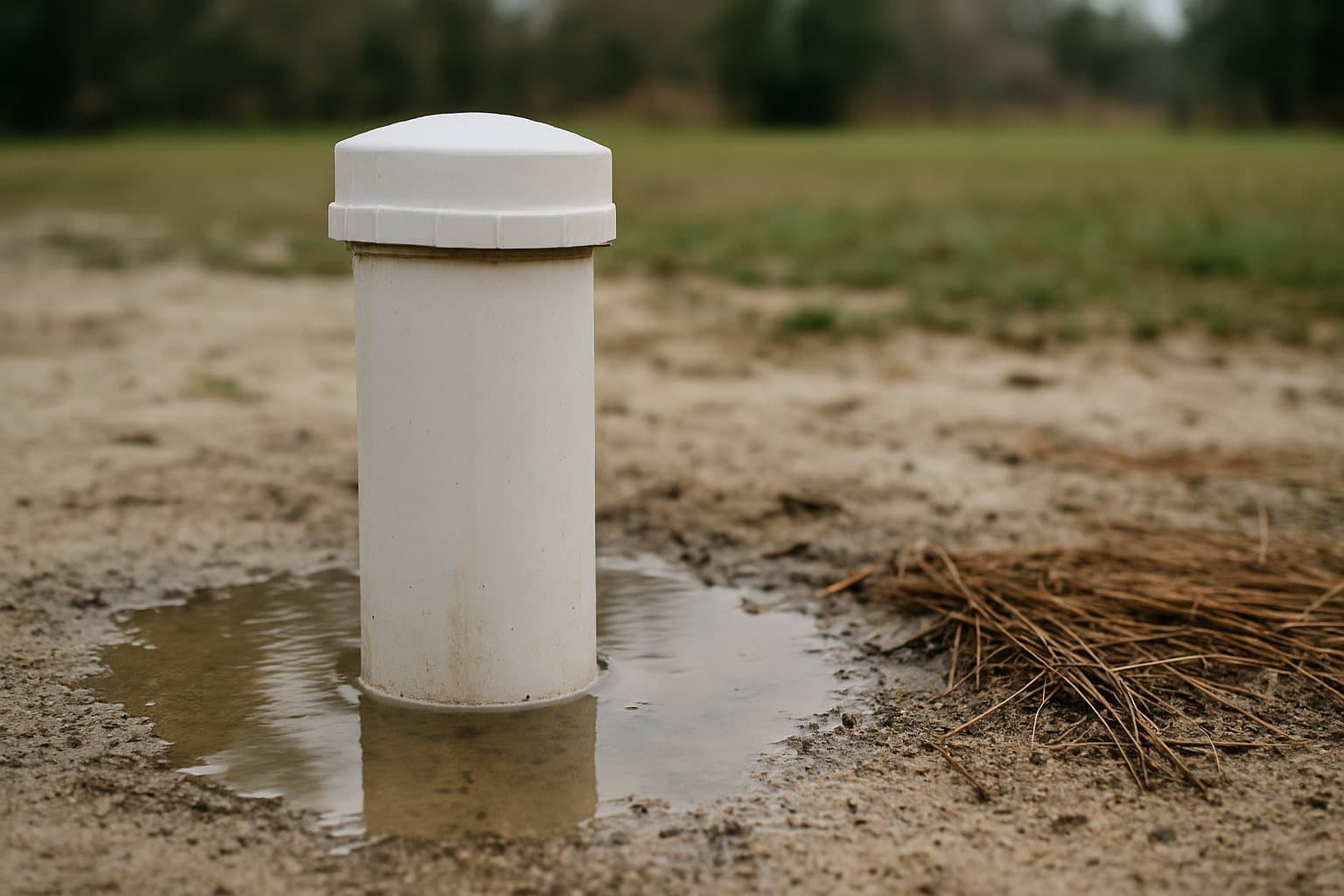
Almost always at or near the wellhead. Alabama's well construction rules exist to block these routes: casing at least 20 feet long extending a foot above ground, a watertight seal against surface seepage, and a cap that keeps contamination out. When one of those fails, surface water finds the gap.
The specific requirements, from ADEM Rule 335-9-1, double as an inspection checklist:
- Casing height. Casing must extend from 1 foot above ground level. A well buried in a pit, or with soil and mulch built up around it, loses that margin.
- Casing length and seal. No less than 20 feet of casing, sealed at an impervious layer. Where no such layer exists above the water-bearing zone, 50 feet of the space around the casing must be sealed, the top 20 feet with grout. Water runs down the outside of a poorly sealed casing far more easily than through undisturbed ground.
- The cap. The rule is simple: capping "shall be such that no contamination can enter the well." A cracked cap, a missing gasket, or an unscreened vent lets in insects and runoff.
- Location. A well must be "free from flooding from any known source of pollution." Ground that slopes toward the wellhead, or a low spot where rain pools around it, defeats every other safeguard.
- Septic distance. A drain field within 100 feet, or a tank within 50, falls inside Alabama's setback. How septic systems reach wells covers this in more detail.
Heavy rain is the pattern to watch. If your positives cluster after storms, the source is almost certainly surface water, and in a shallow, permeable aquifer the response can be quick. After an actual flood, the rules change entirely: a well that was under flood water should be treated as contaminated until tested.
A licensed well driller is the right person to inspect and repair the casing, seal and cap. That is outside what we do.
How long after disinfecting should you retest?
Retest roughly 10 to 14 days after disinfecting, then again two to three months later, per Penn State Extension's guidance. ADPH's procedure ends with a retest and says to repeat disinfection, possibly with more chlorine and a longer contact time, if contamination remains. Two clean results in a row mean more than one.
ADPH's homeowner procedure is short: chlorinate the well, draw chlorinated water to every faucet, leave it overnight (about 12 hours), flush, and retest. We do not disinfect wells. If you are not comfortable doing it yourself, the county health department's environmental health division or a well contractor can help.
The follow-up schedule matters because of how often disinfection alone fails. Penn State Extension reports a study in which disinfection plus a new sanitary well cap removed bacteria for a full year in only 15 percent of wells. Its advice when bacteria return is direct: a continuous disinfection system will be necessary.
When does UV make sense for a recurring positive?
When the source cannot be removed and the water is otherwise clear. A UV system certified to NSF/ANSI 55 Class A disinfects continuously without adding chemicals. It is the right standing answer for a well that stays vulnerable after repairs, not a substitute for fixing a broken cap or casing.
A few things decide whether UV will work at your house.
Class A, not Class B. NSF/ANSI 55 separates UV into two classes. Class A systems are built to treat water that may be contaminated, with a dose of 40 mJ/cm² (per ANSI's summary of the 2024 edition) and a UV sensor tied to an alarm or shut-off. Class B systems are for supplemental treatment of water already considered safe, and are not meant for a well with a bacteria problem.
Clear water in. UV works by light reaching the organisms. Iron, cloudiness and colour absorb that light and coat the quartz sleeve around the lamp. On a well with iron above EPA's 0.3 mg/L secondary level, pretreatment has to come first, and dedicated iron treatment is not something we install. Why that constraint matters so much here is worth reading before you buy anything.
Maintenance. A UV lamp loses output long before it goes dark. Plan on replacing it on the manufacturer's schedule and keeping the sleeve clean.
Keep testing. UV reduces the risk from a vulnerable source; it does not make testing optional. Keep sampling on a schedule so you know it is working.
If a well needs more than one stage, UV is usually the last one, and it is worth designing the whole train together. That is what a complete well water treatment system is for.
If the result is E. coli
Everything above is about total coliform. A positive E. coli result means fecal contamination specifically. Stop drinking the water, use bottled water, and call your county health department promptly. That is not a result to troubleshoot on your own.
Before you buy or sell
A well with a history of positive results is something a buyer should know about, and a lender will want its own test. For FHA and VA loans, the sample has to be collected by a disinterested third party, which rules out the seller, the buyer and any treatment company.
Bacteria testing belongs with the county health department or a state-certified laboratory. When you are ready to look at the rest of the water, our free in-home test screens hardness, chlorine and total dissolved solids at your tap, so treatment is sized to the numbers rather than a guess.
Sources: ADEM Rule 335-9-1 (water well construction standards); ADPH private well guidance and "Procedure for Disinfecting Private Well Water" (rev. 10/25); Penn State Extension's guide to disinfecting wells and springs; NSF and ANSI summaries of NSF/ANSI 55; EPA secondary drinking water standards. Verified 23 September 2026.