

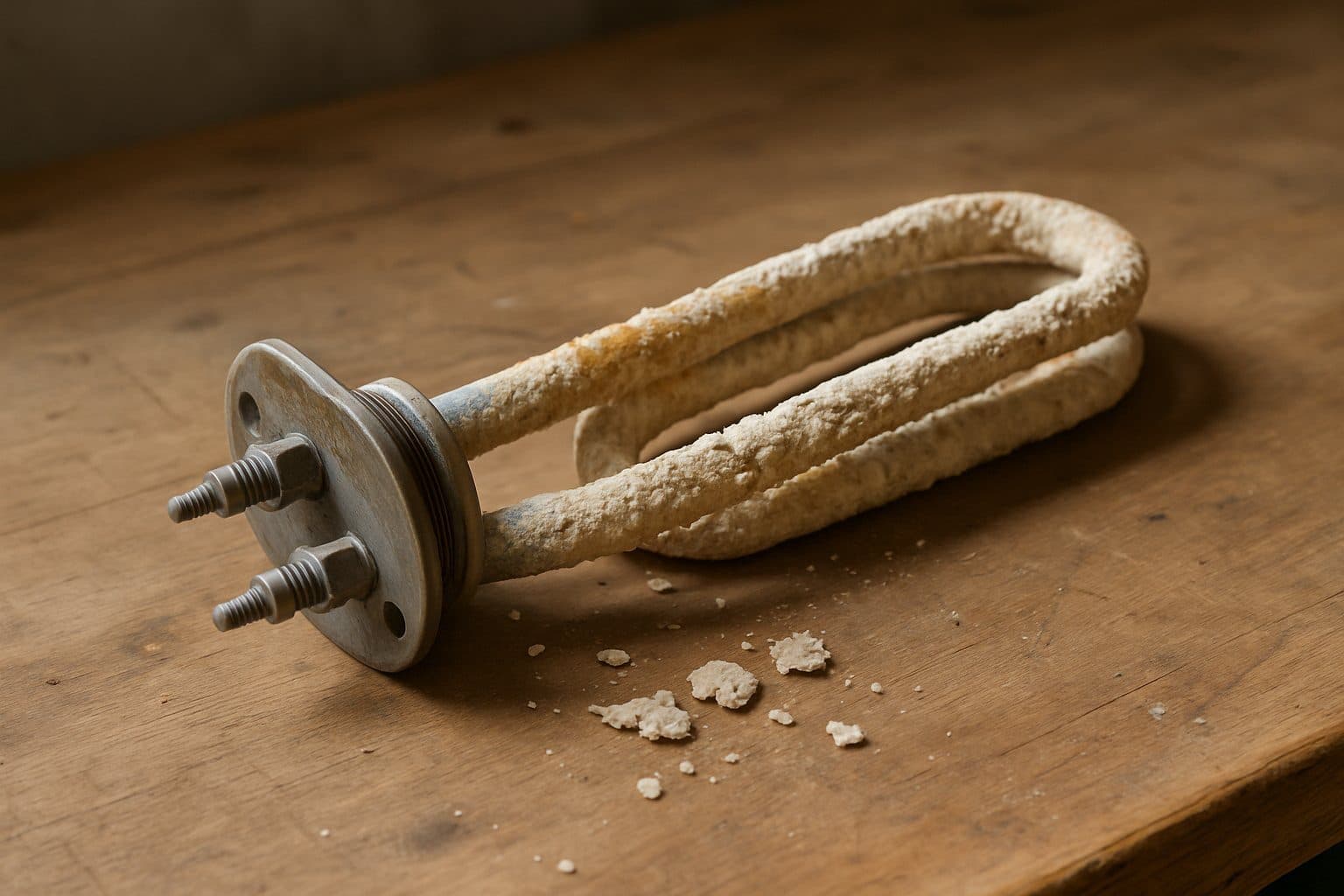
Scale is discussed as though it clogs things. In a water heater it mostly does not — the damage is thermal, and it shows up on a bill long before it shows up as a fault.
The mechanism
Calcium and magnesium are less soluble in hot water than cold. Heat the water and they come out of solution and deposit on the hottest surface available.
In a gas heater, that is the bottom of the tank, directly above the burner. The deposit forms a layer between the flame and the water.
In an electric heater, it forms on the elements themselves, which sit in the water.
Why insulation is the problem
Scale conducts heat poorly. Once a layer exists:
- The burner or element must run longer to raise the same water to the same temperature. That is the energy cost, and it is continuous.
- The metal being heated runs hotter than designed, because the heat is not moving into the water at the intended rate. On a gas heater that thermal stress works on the tank bottom; on an electric heater it shortens element life directly.
So the sequence is: rising energy use, then noise, then component failure, then tank failure. Most people only notice at step three.
The noise is diagnostic
Popping, rumbling or crackling from a gas heater is water trapped underneath the scale layer flashing to steam and forcing its way out.
It is a fairly reliable indicator of a significant bottom deposit, and it generally arrives well before anyone complains about hot water running short. A heater that has started rumbling is telling you something specific.
What flushing does and does not do
Draining the tank periodically removes loose sediment, which is genuinely worth doing and is in most manufacturers' instructions.
Hardened scale bonded to the tank is different. Once it has bonded it often will not flush, and aggressive attempts on an old tank occasionally find the weak spot that was holding. Flushing is best understood as prevention — keeping loose material moving before it consolidates.
Whether this applies to you
It depends entirely on your hardness, and this is where local expectations mislead. Groundwater medians across Mobile and Baldwin counties run low by national standards, so a lot of the scale advice written for the Midwest simply does not transfer.
Which means the question is not "should I prevent scale" in the abstract. It is what does my water actually read — and that varies well by well and, on city water, block by block.
The other consequence worth knowing: on the tankless and high-efficiency equipment increasingly common here, manufacturers have their own water-quality conditions in the warranty. Those are worth reading before assuming any of this applies to your installation.
The honest position
If your water is soft, a softener sold to you on a scale argument is solving a problem you do not have. If it is hard, the cost is real and continuous and shows up on the energy bill rather than as a dramatic failure.
A reading settles it in about half an hour, and sometimes the answer is that nothing needs doing.
The free in-home test reads hardness at your tap. More on what a softener does and does not do.