

People searching for Alabama's private well rules are usually in one of three situations: about to drill, about to buy, or holding a test result and wondering who is supposed to act on it. The rules answer the first situation in detail and the other two hardly at all.
That split is the most useful thing to understand, so it comes first.
Does Alabama regulate private wells?
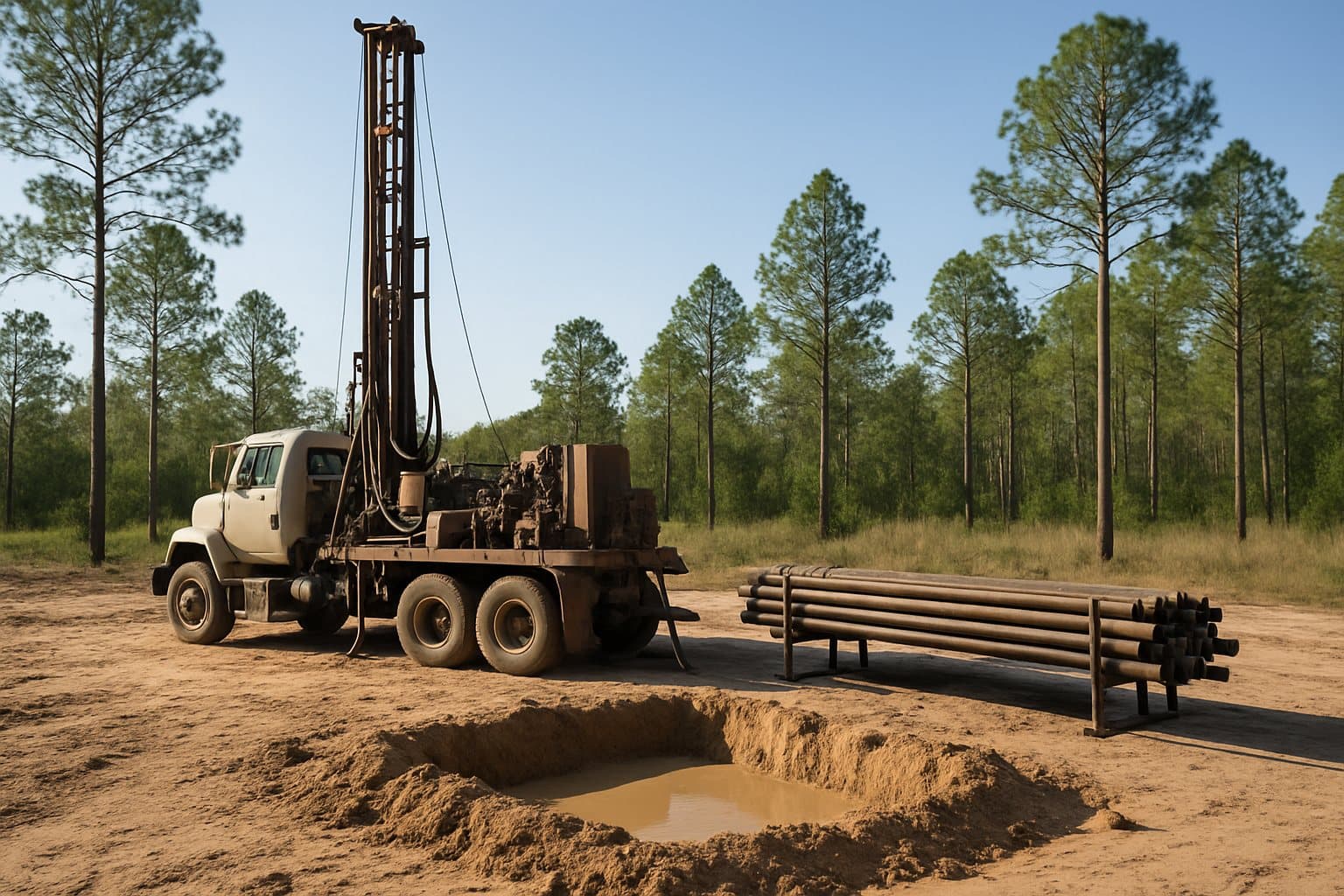
It regulates construction, not water quality. ADEM's water well standards control who may drill, what must be filed, how casing is installed and sealed, and how old wells are closed. No state or federal standard applies to the water a private well produces. Testing and treatment are the owner's job.
The construction rules are in ADEM Administrative Code chapter 335-9-1, "Licensing and Certification of Water and Water Well Construction Standards." They were filed in 1990, and the current published text carries a 1993 supplement date. They are short, and every number below comes from them.
On water quality, the US EPA is explicit: private domestic wells are not regulated under the Safe Drinking Water Act, and private well owners are responsible for delivering safe water to their households. The Alabama Department of Public Health says the same about Alabama. About 800,000 people, roughly 20 percent of the state, depend on private supplies such as wells, and "you are responsible for ensuring it is safe."
For a broader picture of private wells in this part of Alabama, including the aquifer and what it tends to produce, start there.
What does ADEM require of a well driller?
A license, renewed every year, which requires at least two years of well construction work and a passing exam score of 70 percent. Before drilling, the driller files a Notification of Intent. Within 30 days of finishing, the driller files a Certification of Completion, and ADEM notifies the local health authority within 7 days of receiving it.
The detail, from Rule 335-9-1-.03:
- License. Every person who proposes to drill a water well must apply for a water well driller's license by 30 September each year.
- Experience and exam. An applicant must show at least two years of work constructing water wells and score at least 70 percent on an authorised examination.
- Before work. A Notification of Intent to drill is filed with ADEM before work starts.
- After work. A Certification of Completion is filed within 30 days, and ADEM passes it to local health authorities within 7 days.
- Yield test. Under Rule .06, the contractor tests the well's yield and reports it on the completion certificate.
The practical point for a homeowner: a properly drilled well has paperwork. If you are buying a property, ask whether the completion certificate exists. It is the filed record of who built the well, including the yield test.
We do not drill wells. That is licensed work under these rules, and what drives the cost of it is a conversation to have with a driller.
How far must a well be from a septic system in Alabama?
ADEM recommends 100 feet between a well and a septic tank or field lines, and 150 feet from a cess pool, sewage lagoon or barnyard. Separately, ADPH's onsite sewage rules require a septic drain field to sit at least 100 feet from a well and a septic tank at least 50 feet. Local rules can add to both.
| From the well to... | Distance | Status | Source |
|---|---|---|---|
| Roof or building projection | 2 ft | Recommended | ADEM 335-9-1-.04 |
| Secondary electrical service | 10 ft | Recommended | ADEM 335-9-1-.04 |
| Primary electrical service | 75 ft | Recommended | ADEM 335-9-1-.04 |
| Septic tank or field lines | 100 ft | Recommended | ADEM 335-9-1-.04 |
| Cess pool or sewage lagoon | 150 ft | Recommended | ADEM 335-9-1-.04 |
| Barnyard | 150 ft | Recommended | ADEM 335-9-1-.04 |
| Septic drain field (EDF) | 100 ft | Minimum | ADPH 420-3-1, Table 4 |
| Septic tank, pump chamber, D-box | 50 ft | Minimum | ADPH 420-3-1, Table 4 |
ADEM's rule words its table as recommended and adds that the well location "shall comply with local regulations." It also requires every well to be "easily accessible, free from flooding from any known source of pollution." ADPH's table is the one a septic installer has to meet, and it applies to your neighbour's system as much as your own. How septic systems reach wells goes into why those distances matter in sandy ground.
What are Alabama's well construction standards?
Casing must be at least 20 feet long, extend a foot above ground, and be sealed at an impervious layer. Where none exists, 50 feet of the space around the casing is sealed, the top 20 feet with grout. The well gets a watertight cap and is disinfected at 50 ppm chlorine for at least 12 hours after construction.
From Rules 335-9-1-.05 and -.06:
- Casing length and height. Casing extends from 1 foot above ground level to a suitable impervious layer and is sealed there. It may never be shorter than 20 feet without approval from the county environmentalist.
- No impervious layer. Seal 50 feet of the annulus, the upper 20 feet with grout.
- Large casing. Any casing wider than 8 inches inside diameter is grouted to at least 20 feet.
- Minimum size. Mud rotary wells use casing of at least 4½ inches outside diameter unless the county environmentalist approves smaller.
- Materials. New steel casing of at least Schedule 30, or thermoplastic well casing approved by NSF for potable water.
- Cap. Capping must be such that no contamination can enter the well.
- Disinfection. Every new well is subjected to a 50 ppm chlorine solution for at least 12 hours.
These requirements are also the checklist for a well that keeps producing bad bacteria results. A casing that no longer stands a foot proud of the ground, a cracked cap, or a failed seal is where surface water gets in, and a recurring coliform result is usually the first sign.
What happens to an old or unused well?
It must be permanently sealed. ADEM's rule calls for filling the well with puddled clay containing 50 ppm chlorine to within 20 feet of the top, then filling the top 20 feet with cement grout or concrete. Any other holes left from drilling or testing must be backfilled.
Old wells turn up on rural and older suburban lots, sometimes after a house has switched to public water. An open one is a direct route from the surface to the aquifer your neighbours may still drink from. Closing it is a job for a well driller.
What the rules leave to you
Everything about the water itself. Nobody sets a limit on what a private well may contain, nobody requires it to be tested on a schedule, and nobody is notified when it changes. ADPH recommends routine testing and points well owners to the county health department for bacteria, with results about 24 hours after the sample reaches the lab.
That is where knowing where to get a well tested comes in, and the numbers to watch are ones like nitrate and bacteria.
When you are buying or selling
A sale is often the first time anyone tests a well in years, and the lender usually drives it. FHA and VA loans generally require a water test collected and transported by a disinterested third party, which rules out the buyer, the seller and any treatment company.
What we can do sits alongside that test, not in place of it. Our pre-purchase water testing service is for the buyer's own information: what the water is doing while there is still room to negotiate. It does not replace the lender's test.
For bacteria, nitrate or any legal decision, use the county health department or a state-certified laboratory. For hardness, chlorine and total dissolved solids, our free in-home test is a quick screen at your tap.
Sources: ADEM Administrative Code chapter 335-9-1 (Rules .01 to .06, filed 30 April 1990); ADPH Rule 420-3-1, Table 4 (revised 13 February 2023); US EPA, "Private Drinking Water Wells"; ADPH, "Well Water." Verified 23 September 2026. This is a plain-language summary, not legal advice; ADEM and your county health department have the final word.