
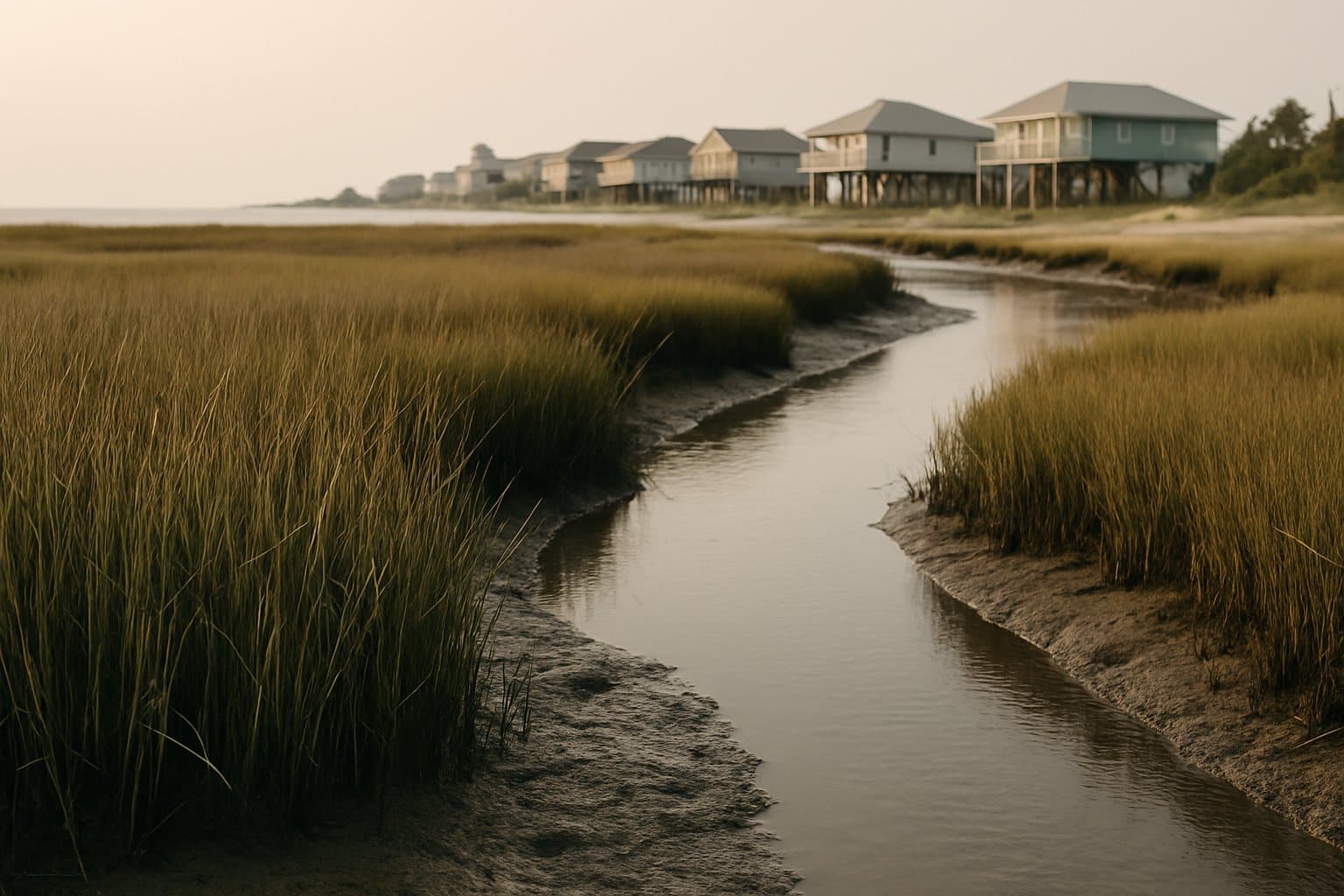
Along the Alabama coast, fresh groundwater floats on top of denser salt water. Where the two meet is not fixed. Pumping and storm surge can pull or push that boundary toward a well, and when it arrives, a salty taste is often the first clue.
This post is the detailed version of a point made briefly in how shallow the water table gets near the coast: where saltwater intrusion has actually been measured here, and what can be done about it.
We design complete well water treatment systems for coastal wells, and salt is one of the few problems where part of the answer sits outside what we install. That is covered honestly below.
Is saltwater getting into wells in coastal Alabama?
In the shallowest aquifers nearest the Gulf, yes. Researchers sampling wells across southern Baldwin County in 2006 and 2007 found chloride and dissolved solids above EPA's secondary levels near Gulf Shores, part of Fort Morgan Peninsula, Orange Beach and Ono Island, and in a deeper zone at Romar Beach. Inland and deeper wells showed far less.
That study, by Dorina Murgulet and Geoffrey Tick of the University of Alabama (Salt Water Intrusion Meeting, 2008), drew on about 200 wells. It identified the Gulf of Mexico and the Intracoastal Waterway as the main sources, and found the deepest aquifer zone it sampled did not show significant saltwater degradation.
The problem is older than that. The USGS's 1996 groundwater report for Baldwin County recorded groundwater with dissolved solids above 1,000 mg/L, chloride of 500 mg/L and a sulfurous odour adjacent to the Mobile River and locally near the Gulf. It also noted water levels in the Gulf Shores and Orange Beach areas less than 5 feet above sea level in places.
More recent work points the same direction. A 2025 study in Scientific Reports, with a USGS co-author, modeled the southern Baldwin coast and found:
- The shallow part of the coastal aquifer system is more vulnerable to sea level rise and pumping than the deeper layers.
- The modeled freshwater-saltwater boundary moved landward over the decade from 2013.
- Storm surge from Tropical Storm Claudette in June 2021 pushed salt water inland, with effects lasting about nine months.
- In one modeled area, a 50 percent increase in pumping moved the seawater front about 320 meters inland over ten years; a 50 percent cut pulled it back about 270 meters.
None of this says your well is salty. It says where to pay attention: close to the Gulf, the bays and the Intracoastal Waterway, in shallow wells, and after a major storm.
What are the signs of saltwater in a well?
A salty or brackish taste is the usual first sign, often gradual. EPA links a salty taste to chloride above 250 mg/L. A rising total dissolved solids reading over several tests is the other clue. Only a laboratory analysis for chloride and sodium confirms it, and a single reading tells you far less than a trend.
The yardsticks, from EPA:
| Measure | Level | What it means | Source |
|---|---|---|---|
| Chloride | 250 mg/L | Secondary standard; salty taste above it | EPA secondary standards |
| Total dissolved solids | 500 mg/L | Secondary standard; taste, deposits, staining | EPA secondary standards |
| Sodium | 20 mg/L | Guidance for people on a 500 mg/day sodium diet | EPA sodium advisory |
| Sodium | 30 to 60 mg/L | Range EPA recommends for taste | EPA sodium advisory |
Secondary standards are not enforced, and no standard at all applies to a private well. They are still the right way to read a result. Anyone on a sodium-restricted diet should talk to their doctor about a well that is trending salty, since EPA specifically flags that group.
Keep every result. Where to get a well tested covers the options, and for chloride and sodium specifically you want a state-certified laboratory.
Can a water treatment system remove salt from well water?
For drinking and cooking, yes: reverse osmosis reduces dissolved salts, including sodium and chloride, at the tap where it is installed. For the whole house, not with anything we install. A water softener does not remove salt. If a well has turned brackish throughout, the lasting fixes are at the source.
Here is how the options sort out.
Under-sink reverse osmosis. An RO membrane rejects most dissolved salts. The tankless under-sink RO system we install carries a manufacturer salt rejection rating of at least 93.6 percent. That makes it a sound answer for drinking and cooking water on a well with elevated chloride or sodium. It treats one tap.
Whole-house RO. Reverse osmosis for every tap in the house is not something we install.
Water softeners. A softener swaps hardness minerals for sodium. It does not lower chloride or sodium; it adds a little sodium. It is the wrong tool for a salt problem.
The source. If the well itself is drawing brackish water, the lasting options sit with a well driller, such as a deeper well into a fresher zone, or with connecting to a public supply where one is available. What Alabama requires of well construction applies to any new well.
For the other things a coastal well produces, a treatment system designed around your specific numbers still makes sense. We would rather tell you early that salt is partly outside our scope than find it out after an install.
Does a hurricane make it worse?
It can, in two different ways. Storm surge can push salt water into the shallow aquifer from below, and the 2025 study found that effect lasted about nine months after Tropical Storm Claudette. Separately, surge or flood water over the wellhead contaminates the well directly, which is a bacteria problem first.
The second is the one to act on immediately. A well that has been under flood water should be treated as contaminated until the county health department's test says otherwise.
The first is slower. If your water tastes different in the weeks after a storm and does not recover, test for chloride and total dissolved solids, and test again a few months later. The research suggests a surge-driven change can take most of a year to fade.
If you are buying on the coast
A salty well is expensive to discover after closing. Ask the seller for any past test results, taste the water yourself, and know that an FHA or VA lender will usually require its own test collected by a disinterested third party. A chloride and sodium result from a state-certified lab is worth adding if the property is close to the water.
Our free in-home test is a screen, not a lab analysis. It reads hardness, chlorine and total dissolved solids at your tap, which is enough to spot a TDS number worth following up, and to size an RO system if drinking water is the concern.
Sources: Murgulet and Tick, "Assessing the Extent of Saltwater Intrusion in the Aquifer System of Southern Baldwin County, Alabama," 20th Salt Water Intrusion Meeting (2008); USGS Open-File Report 96-487; Gholizadeh et al., Scientific Reports 15 (2025), USGS Publications Warehouse 70270114; EPA secondary drinking water standards; EPA Drinking Water Advisory on sodium (2003). Verified 23 September 2026. Regional findings describe an area, not your well.