

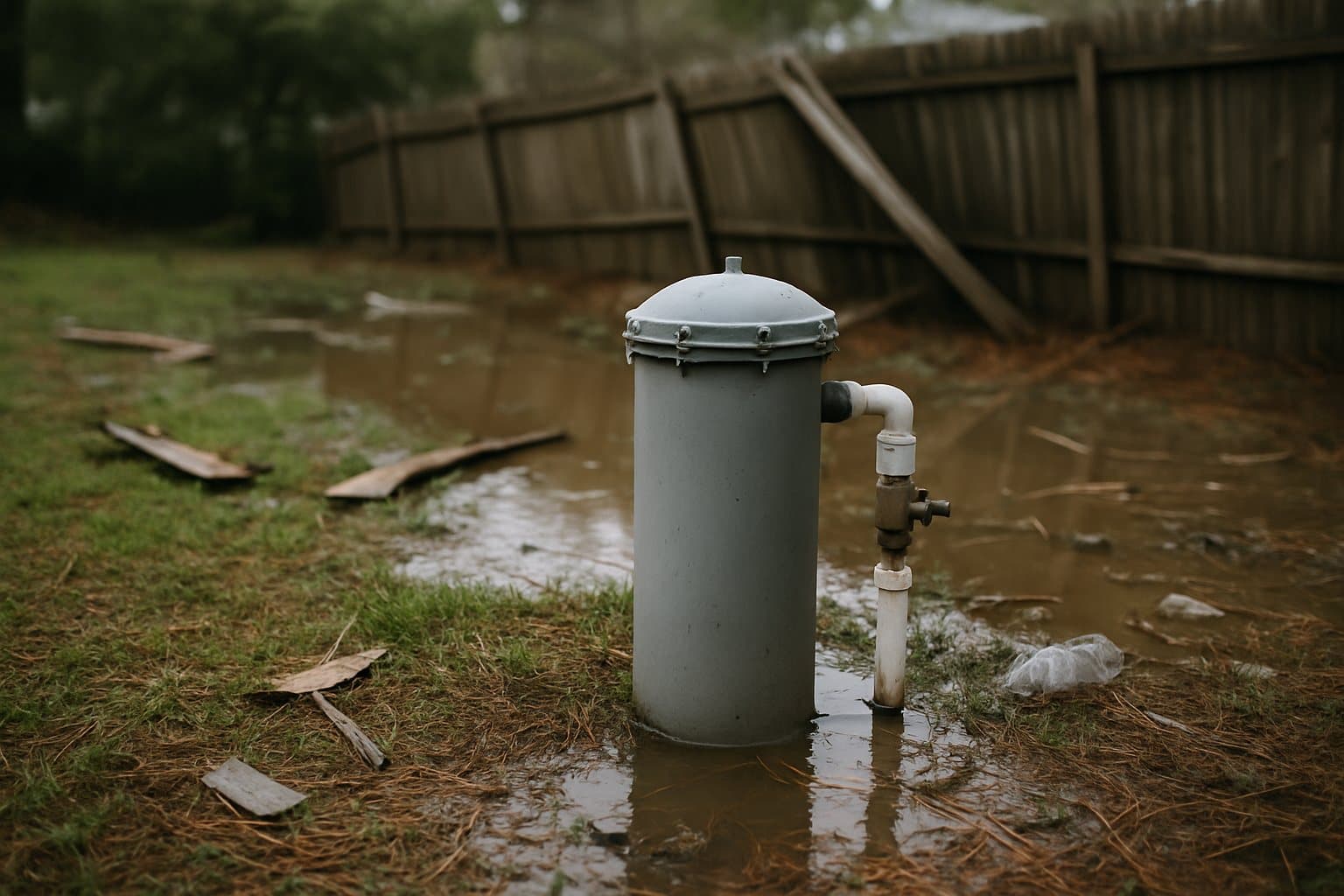
If flood water reached your wellhead, the Alabama Department of Public Health's guidance is short: assume the well is contaminated. Don't drink it or give it to animals until it has been disinfected, tested and come back satisfactory. Until then, use bottled water or clear water boiled for one minute.
That's easy to say and harder to do with the power out and the yard under water. This post sets out the order of steps, where the official guidance comes from, and who does which part. That includes the parts we don't do.
Why does ADPH say to assume contamination?
Flood water carries whatever it crossed: septic effluent, animal waste, fuel and farm runoff. A wellhead covered by it gives all of that a direct route into the well. ADPH doesn't ask you to prove contamination. It asks you to assume it, because the costs of the two possible mistakes are nowhere near equal.
The wording comes from ADPH's own storm advisories. After Tropical Storm Zeta the department said that "private wells that have been covered by flood water should be assumed to have been contaminated," and told residents not to drink the water or feed it to animals until it had been tested.
EPA's flood fact sheet, What to Do After the Flood, goes further. Wells more than 10 years old or less than 50 feet deep "are likely to be contaminated, even if there is no apparent damage." Plenty of wells in coastal Baldwin and south Mobile County fit that description, especially where the water table sits close to the surface.
This is also the part of storm recovery we sell, as post-storm water response. So it's worth being clear up front about where that begins and ends.
What should you do first when your well has flooded?
Stay away from the pump and don't switch it on. EPA warns that a flooded pump and control box can cause electrical shock and damage the pump. Wait until everything has dried and the wiring has been checked by a qualified electrician, well contractor or pump contractor. Meanwhile, drink bottled or boiled water.
In order:
- Don't drink it, cook with it or wash with it. EPA's fact sheet warns that people washing with water from a flooded well also risk getting sick.
- Leave the pump off. Rubber boots and gloves are not enough protection from shock, EPA says. If the control box was submerged, every electrical component has to be dry before power goes back on.
- Get the wiring checked by an electrician, well contractor or pump contractor before switching on. EPA also notes that sediment in flood water can erode pump parts, which a pump contractor can clean.
- Switch treatment equipment to bypass. If you have a softener, carbon filter or UV system, keep flood-contaminated water and disinfection chlorine out of it. EPA's procedure tells owners to put a treatment system on bypass before running chlorinated water to the taps.
- Have the well disinfected. See the next section.
- Test before trusting it. See the section after that.
How is a flooded well disinfected?
Chlorine goes into the well casing, gets drawn through every faucet, and sits in the plumbing for hours before being flushed out. ADPH publishes a six-step version and EPA publishes a nine-step one. EPA adds that drilled, driven and bored wells are best disinfected by a well or pump contractor, because owners find them hard to do thoroughly.
We explain the procedure so you know what should happen. It is not a service we offer, so we do not do well shock chlorination ourselves, and we'd point you to a well contractor or your county health department for it.
ADPH's private well page sets out the sequence:
| Step | ADPH procedure |
|---|---|
| 1 | Sample the well water to find out whether disinfection is needed |
| 2 | Add half a gallon of chlorine solution, such as unscented bleach, to the well and wait about an hour |
| 3 | Starting nearest the well, run each faucet until you smell chlorine |
| 4 | Leave all faucets off overnight, about 12 hours |
| 5 | Starting nearest the well, run each faucet until the chlorine smell is gone |
| 6 | Re-test the well |
EPA's version calls for a gallon of bleach and a wait of 6 to 24 hours, and says to run the flush water somewhere it won't reach plants, streams or the septic tank. The two sets of figures don't match, which is one more reason to have whoever does the work size it to your well's depth and casing.
Two limits apply to all of this. Disinfection doesn't remove what caused the contamination. And EPA is explicit that it "will not provide protection from pesticides, heavy metals and other types of non-biological contamination." If fuel or chemical drums washed onto your property, EPA says to call the state or county health department.
When is the water safe to drink again?
When a bacteriological test taken after disinfection comes back satisfactory, and not before. EPA says to test 7 to 10 days after disinfection. In Alabama your county health department supplies the container and handles the test, and ADPH says results come back about 24 hours after the sample arrives.
ADPH's well page says the containers have to come from your county health department. You can collect the sample yourself or ask for an environmentalist to collect it, and there may be collection and testing fees. We covered the options in more detail in where to get your well water tested in Alabama.
One clean result isn't the end of it after a flood. EPA warns that because of the flooded area and the way groundwater moves, "your well may not be a safe source of water for many months after the flood." It recommends repeated testing, and ADPH's storm guidance says to keep monitoring with further samples once a satisfactory one is in.
If a result comes back positive, the next step depends on which organism was found. We explain the difference in your well tested positive for coliform.
What happens to treatment equipment after a flood?
Anything that stored flood water or was downstream of it needs attention before you rely on it again. Cartridge filters that held contaminated water get replaced. A softener needs a regeneration once the water is clean. A UV system needs its lamp, sleeve and alarm checked, and its manufacturer's manual will usually call for the plumbing after it to be cleaned before it goes back in service.
This is where we come in. Our post-storm response is the equipment side of recovery. Once the well has tested clean, we swap fouled cartridges, flush sediment out of the lines, inspect the UV unit and put the system back in service. We work same-day during business hours, Monday to Friday.
If this storm showed that your well can't be relied on, ongoing disinfection is worth considering. UV is the standard long-term answer to a vulnerable well, as one stage of a complete well water treatment system. The caveat is local: UV only works on water that meets its pre-treatment limits, and many wells here run too high in iron for that. We'll tell you if yours is one of them.
The short version
- Flood water over the wellhead means the well is contaminated until a test says otherwise.
- Leave the pump off until the wiring has been checked.
- Disinfection is for a well contractor or health-department guidance, not for us.
- Test 7 to 10 days after disinfection, and keep testing.
- Bypass treatment equipment first, then get it back in service once the water is clean.
Once the health department has cleared the well, book the free in-home water test to see what the water is doing now. It's a screen for hardness, chlorine, total dissolved solids and a soap test, read at your tap. It is not a bacteria test, so the question of whether the water is safe to drink stays with the county health department or a state-certified laboratory.
General guidance, not a substitute for your county health department. If anyone in the household falls ill after drinking well water, contact a doctor and the health department.