

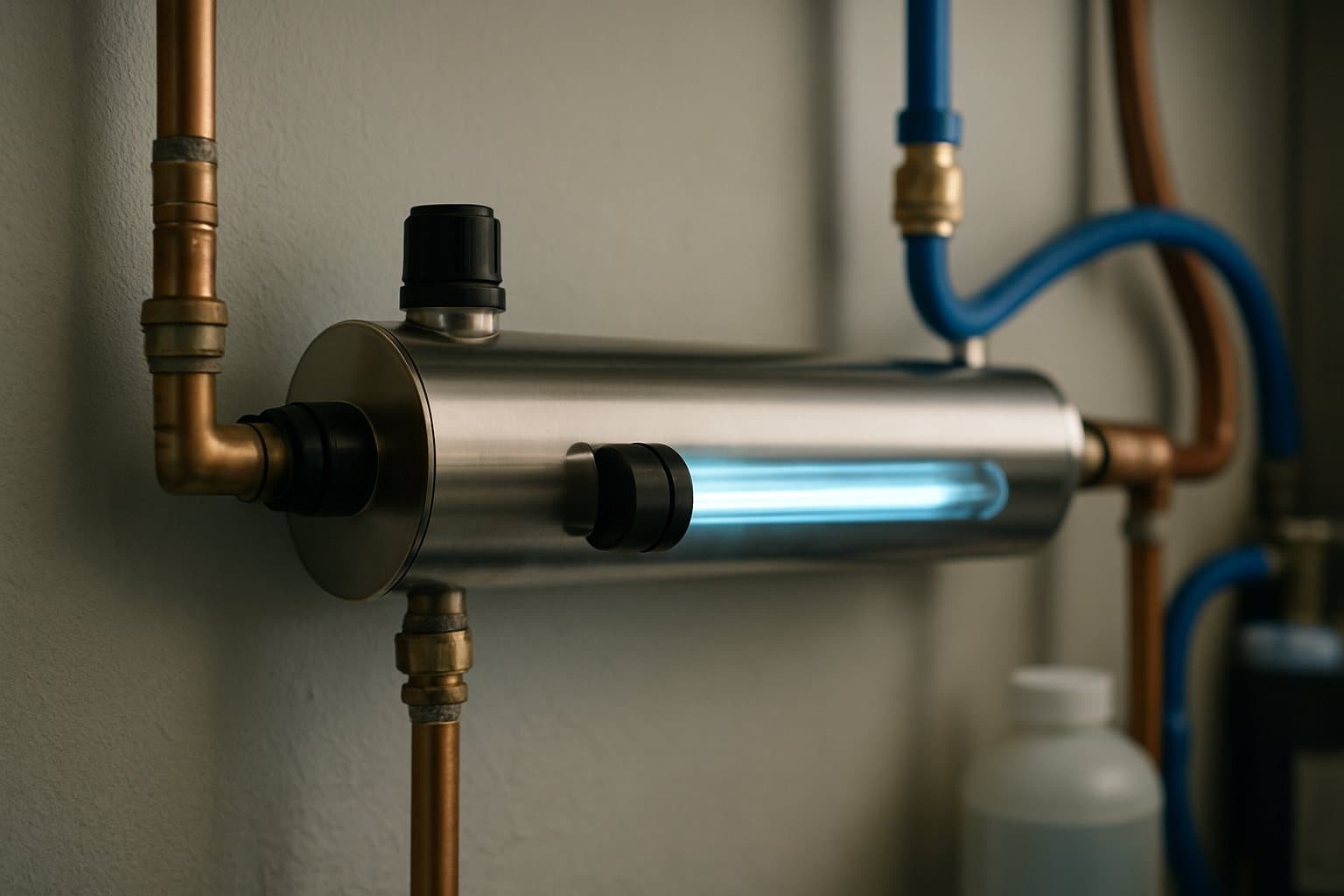
A UV disinfection system has one moving part that matters, and it does not move. The lamp either delivers enough ultraviolet light to the water or it does not. Nothing at the tap tells you which.
That is the case for replacing the lamp on a schedule rather than on appearance.
Why does a UV lamp need replacing if it still glows?
Because the blue glow is visible light, and the disinfecting light is ultraviolet, which you cannot see. A lamp's UV output falls with use while the visible glow can look unchanged. Manufacturers rate lamps by operating hours for that reason, and expect them replaced at the end of that rating whether or not they still light.
The clearest statement of this comes from the manufacturers themselves. VIQUA's owner's manuals, for example, say that the presence of visible blue light "does not mean equivalent performance," and that unless the equipment has a UV sensor, it is not possible to verify the UV output of a lamp (VIQUA owner's manual MNL520110).
We install and service UV disinfection systems, including lamp and sleeve replacement. The rest of this post is what we would tell you on the visit.
How long is 9,000 hours?
About a year. A UV system runs continuously, and 9,000 hours works out to 375 days of continuous operation. That is why VIQUA's manuals say the lamp "must be replaced after 9000 hours of continuous operation (approximately one year)" and recommend annual replacement. Other models carry different ratings, so check yours.
A few details matter here.
- The clock runs whether or not you use water. The lamp stays lit between draws so the water sitting in the chamber is treated. Hours accumulate even in a quiet house.
- Not every lamp is rated the same. VIQUA's instruction sheet for at least one of its models gives a lamp life of approximately 18,000 hours (VIQUA instruction sheet ISH602962). The number on your system's label or manual is the one that counts, not a rule of thumb.
- Seasonal homes differ. VIQUA's manuals allow for replacing every two years in a seasonal home where the system is not running year-round.
- Many controllers count down for you. Some systems show the days of lamp life remaining and sound an alarm at zero. Silencing that alarm and carrying on is an easy way for a lamp to end up two years old.
How can you tell if a UV system is actually working?
Only with a UV sensor, and even then only for the dose, not the lamp's remaining life. Systems certified to NSF/ANSI 55 Class A must carry a UV sensor linked to an alarm or shut-off. Without one, you are relying on the lamp's rated hours, a clean sleeve, and periodic bacteria testing.
NSF/ANSI 55 divides UV systems into two classes. Class A systems are intended for water that may be contaminated. They are validated to a 40 mJ/cm² dose (ANSI's summary of the 2024 edition) and must have a sensor that reads ultraviolet specifically, connected to a visual or audible alarm or a valve that stops the water (WC&P's review of the standard). Class B systems are for supplemental treatment of water already considered safe, and are not required to have a sensor.
On a sensor-equipped system, the controller typically displays UV intensity as a percentage and alarms when it drops too low. A low reading has several possible causes, and VIQUA's manuals list the usual suspects: a lamp past its rated life, a stained or dirty sleeve or sensor window, a voltage problem, or a change in the water coming in.
If your system has no sensor, check the lamp's installation date and your last bacteria test. Those two facts are all you have.
What else needs replacing besides the lamp?
The quartz sleeve needs regular cleaning and eventual replacement. Minerals and iron in the water coat the glass sleeve around the lamp, cutting the UV that reaches the water. A fouled sleeve can undo a new lamp, so the sleeve should be inspected and cleaned whenever the lamp is changed, and more often on hard or iron-bearing water.
VIQUA's manuals put it plainly: minerals slowly form a coating on the quartz sleeve, the coating reduces the UV reaching the water, and a sleeve that cannot be cleaned must be replaced.
This is where local water matters. On wells with iron, the sleeve can foul well before the lamp is due, and it does so silently. The lamp keeps glowing, the dose keeps falling. Dedicated iron treatment is not something we install, and if iron is fouling your sleeve faster than a sensible cleaning schedule can keep up with, we will tell you that pretreatment has to come first.
Two practical notes from the manuals:
- Use the manufacturer's lamp. VIQUA warns that non-genuine replacement lamps have been shown to damage its control modules, and that damage from them is not covered by the equipment warranty.
- Reset the timer. On systems that count lamp life, the countdown has to be reset after the new lamp goes in, or the next reminder will be wrong.
Old lamps contain mercury. VIQUA's manuals point to lamprecycle.org for disposal rather than the household trash.
What does a late lamp change risk?
A dose below what the system was validated for, with no visible sign. If the UV is there because the well is vulnerable to bacteria, a weak lamp leaves the house relying on protection that has quietly faded. That is why periodic bacteria testing matters even with UV installed.
If you are not sure how old your lamp is, treat it as due. And if your well has a history of positive results, the reasons they keep coming back are worth reading alongside this.
Power interruptions are the other thing to know about. A UV system does nothing while it is off, so water drawn during an outage may not have been treated. What UV and softeners need after an outage covers what to check when the power comes back.
Keeping it on a schedule
The easiest way to stop a lamp from going two years is to put it on someone else's calendar. If you would rather not track it yourself, ask us about the $34.95/month maintenance plan and what it covers for your equipment.
If you are buying a house with a UV system already installed, ask the seller when the lamp was last changed and whether there are recent bacteria results. A lender on an FHA or VA loan will usually require its own water test, collected by a disinterested third party.
Bacteria testing belongs with your county health department or a state-certified laboratory. For the rest of the picture, our free in-home test screens hardness, chlorine and total dissolved solids at your tap.
Sources: VIQUA owner's manuals MNL520110 and MNL520520 and instruction sheet ISH602962; NSF consumer guide to NSF/ANSI 55; ANSI summary of NSF/ANSI 55-2024; WC&P, "Evaluation of POU and POE UV Systems under NSF/ANSI 55" (October 2022). Verified 23 September 2026. Your system's own manual governs its maintenance intervals.